


Menu
By theme
By theme





{{ variable.name }} : {{ variable.values[selectedVariantsIndex[variable_index]].name }}
Quantity:
The Chinese name Dashi Zhi translates a meaning rather than a sound; the Sanskrit term says something like "one who has arrived with great power". Sutras say that when he walks, the ground of the ten directions shakes, and the same when he sits, and from this comes the name. It sounds fierce, but his position is not. Among the Three Saints of the West, Amitabha sits at the center, Avalokiteshvara and Mahasthamaprapta flank him left and right, and his is the path of wisdom. Another passage describes him lighting everything with the light of wisdom: beings who meet that light can leave the three lower realms and gain unhindered strength. That is where "great power" lands.
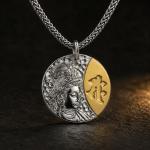
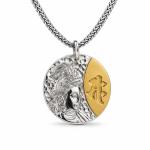
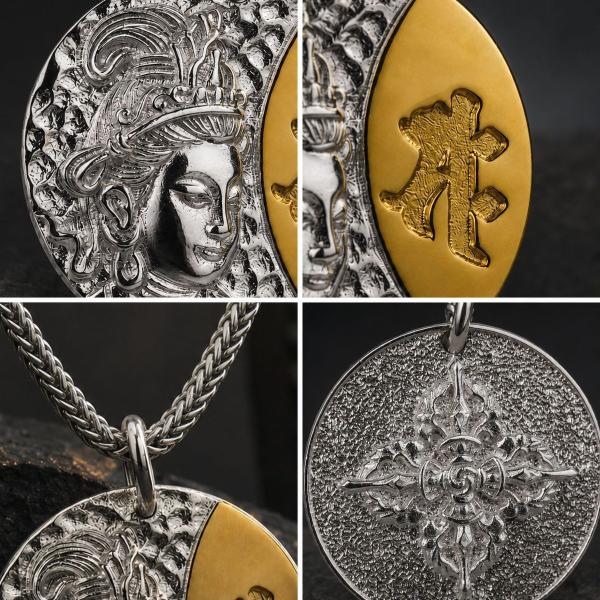
What is cut into the pendant is a seed syllable. The term comes from tantra: a single Sanskrit letter stands for one buddha or bodhisattva, the letter a compression of the sound, and recitation rests on that sound the way a seed falls to earth and grows a tree. Few strokes make the work harder, not easier. A character with many strokes can hide its flaws; one arc and one dot, off by half a hair, and the whole thing falls apart. Here the syllable sits centered on the face with wide blank margins around it, a fine raised border holding it in. The strokes are cast rather than engraved afterward, and cast edges carry a slight roundness, so they do not cut the finger and do not trap sweat.
The silver is not heavily antiqued; only the recesses of the syllable are darkened. From a distance it is a plain white field, and up close the letter appears. Pendants like this are mostly worn outside clothing, the syllable facing out, meant for the wearer, with no need to explain itself to anyone else. Inside the clothing works too, since the back is polished flat and does not press. People ask whether the syllable should face in or out. The old tantric rule is against the skin, meaning not shown to strangers; nowadays most wear it facing out, and either way is a matter of convenience.
The hole is drilled at top center, and a plain chain hangs most steadily. A chain over two millimeters makes the pendant look small; under one millimeter cannot hold it. Around 1.2 mm is right, with the pendant landing two fingers below the collarbone. Dark cotton cord or braided cord also works, the knot tucked behind the pendant so the front stays clean. Set the clasp slightly behind the pendant, or it will always list to one side and the syllable will sit crooked.
Silver darkens in air, faster in summer. Polish in one direction with a silver cloth, not in circles; circles turn a polished face into a fog. Store it in a sealed bag when it is not worn, and do not toss it in a drawer with keys and coins. Scratches on a plain face are the hardest to hide. Silver's hardness comes from that 7.5 percent alloy ratio. Pure silver is too soft and the strokes will not stand up; other metals give it the hardness, at the cost of oxidation over time.