


Menu
By theme
By theme


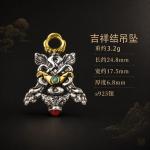
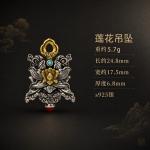
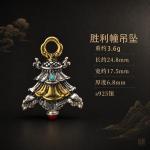
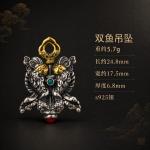
{{ variable.name }} : {{ variable.values[selectedVariantsIndex[variable_index]].name }}
Quantity:
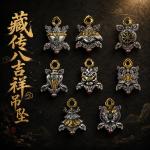
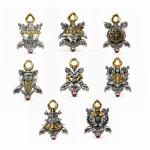
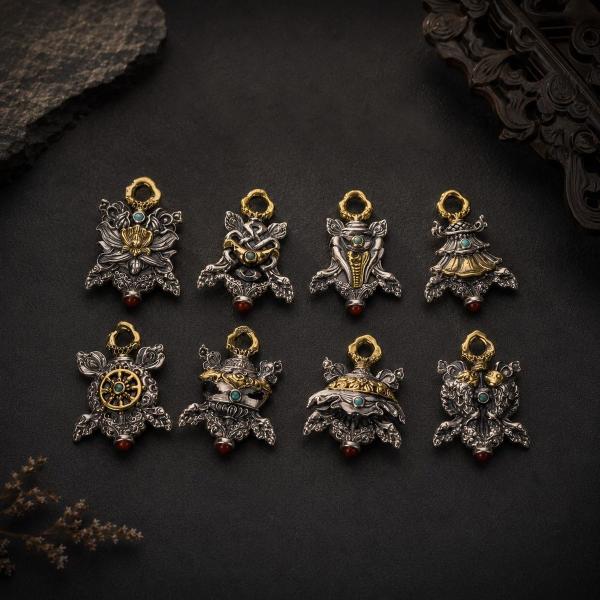
The eight auspicious symbols come as a set in Tibetan tradition: the parasol, the golden fish, the treasure vase, the lotus, the right-turning conch, the endless knot, the victory banner and the golden wheel. Each has its own reading, and together they make a complete offering. In murals they run from before the buddha all the way to the lintel, and they often fill the four corners of a thangka. The order shifts a little from place to place. Starting with the parasol is the most common arrangement, running down from shelter to the sound of the teaching.
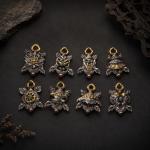
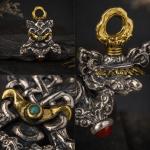
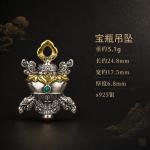
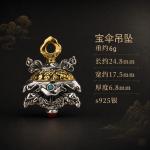
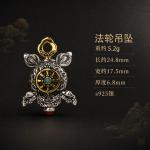
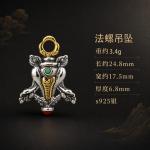
This batch makes six of them, leaving out the treasure vase and the victory banner. The conch is the right-turning kind, its mouth spiraling inward to a point. The pair of fish swim toward each other, fins and tails cut separately. The wheel has eight spokes of equal thickness; one crooked spoke and the whole wheel falls apart. The knot is a loop of line, one strand over the next, with no visible beginning or end. The parasol opens its ribs with tassels hanging from the canopy. The lotus has two layers of petals, the outer ones turned out and the inner ones held in. Wheel and knot are the hardest to cast, one for its fine spokes and the other for its loops, and both tend to tear at the edge when they come out of the mold.
Looked at singly, all eight are small things; together they make the sentence. You do not need the whole set. Pick the ones that mean something to you: the parasol for someone who travels often, for shelter; the conch for someone who recites often; the knot for a tangled mind, since the figure has no start and no end. Some choose by color instead. Silver white against Tibetan red or deep blue looks well, and three different pieces on one cord knock together as you walk.
In silver, all six come down to one word: thin. The canopy of the parasol and the teardrop edge of the lotus are made thin. Too thick and they go clumsy; too thin and they collapse under a press. Each piece is trimmed by hand after casting, and one heavy stroke of the file curls the edge and sends it back to the melt. Then polishing. Polishing is the most punishing step of the whole job: the recesses must not be touched, the raised parts must be taken through, and one lapse of attention takes it too far.
A single piece works as a necklace pendant; two or three can be strung into one. Tibetan red or deep blue cord holds them down, while pale colors look adrift. The eight symbols appear on textiles and woodwork in Tibet as well, and this small silver piece moves the pattern onto the body. You needn't collect all eight. One piece is one meaning, and more becomes clutter. When you change pieces, untie the knot and retie it rather than cutting and restringing, since the cord end gets shorter every time.