


Menu
By theme
By theme

{{ variable.name }} : {{ variable.values[selectedVariantsIndex[variable_index]].name }}
Quantity:
A charm coin is not money. It copies the shape of a copper coin, square hole and round rim, but never circulated. It was made to be carried, hung, or kept at the bottom of a chest. The mountain ghost coin is one branch of the type, coming out of the Daoist talisman tradition. There is no reign title on the face, only a ring of talisman characters. In the old days these hung on curtain hooks and door rings, and were sewn into children's lapels, always something carried on the person.
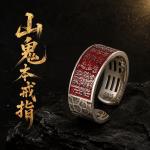
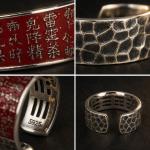
It is normal not to recognize the characters. Talisman script is a different system from regular script: strokes pile on strokes, some places joined into a single line, others broken, looking like writing without being writing. Old craftsmen could not read the talismans and carved them anyway, working from rubbings and mnemonic verses. One wrong stroke and the whole talisman was spoiled. The back of a charm coin is usually the eight trigrams, sometimes a thunder command. This mountain ghost type has the strangest face of all: two large characters at the center reading "mountain ghost", a ring of talisman script around them, the characters stacked vertically. The strokes need breathing gaps between them. Joined dead, the talisman does not flow. That is the old saying about cutting talismans.
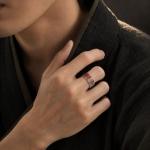
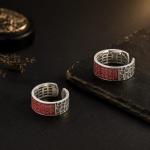
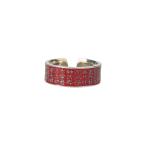
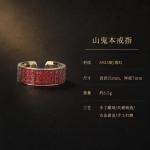
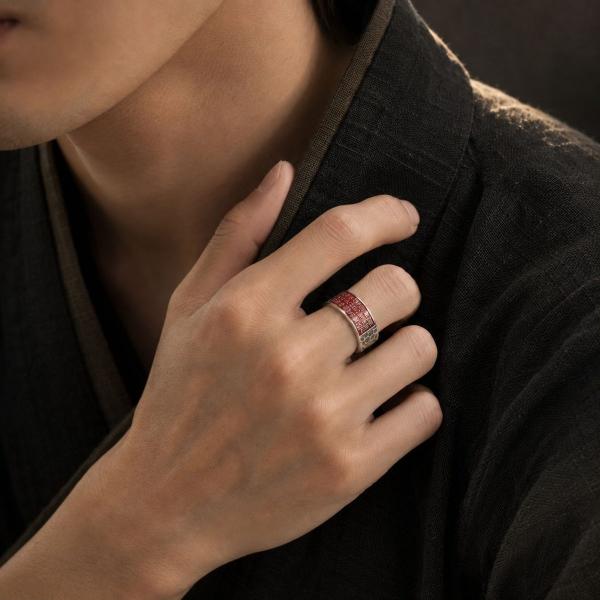
Made into a ring, it takes the wide face. The coin was round; on a finger it has to be drawn into an arc, the pattern broken at the middle and rejoined around the finger, with the joint on the palm side so the front reads continuous. The advantage of a wide face is that the design can spread out; the disadvantage is that it will not pass the knuckle. That is what an open-back style is for: pry it slightly apart, slip it on, close it again. A wide face has another use. On short fingers it does not feel cramped, and the spread design draws the knuckle out longer.
Adjustable does not mean endlessly adjustable. Silver fatigues; bend the same spot a dozen times and a white line appears, and the next bend breaks it. Set it once and then put it on the way it is, instead of pinching it every time. Use a cloth when adjusting and part it slowly with two fingers, half an inch at a time being enough. Open it too far and it will not close again, and you are left wearing it as an open ring.
Either hand works. A wide band does not stack well; a thin ring beside it will grind against it. On a hand that works, the base of the finger sweats and the silver tarnishes quickly. Take it off at night and wipe it once, and leave the black in the lines, since that is what makes the pattern stand. Wide bands and thin rings are not of the same family, and on one hand there has to be a hierarchy, or the whole hand looks messy.