


Menu
By theme
By theme







{{ variable.name }} : {{ variable.values[selectedVariantsIndex[variable_index]].name }}
Quantity:
The nine palaces are a grid of three by three with one to nine filled in, so that every row, every column and both diagonals add up to fifteen. The arrangement is called the Luoshu, and the old mnemonic runs: nine on the head, one underfoot, three to the left, seven to the right, two and four for the shoulders, six and eight for the feet, five in the center. A nine-palace plaque cuts that grid into metal. The Luoshu arrangement is very old; the five at the center does not move, and the other eight numbers turn around it, a full turn to a year.
In Tibetan calendrical reckoning the nine palaces are not a static grid. Each of the nine numbers has a color and a name — one white, two black, three jade, four green, five yellow, six white, seven red, eight white, nine purple — and they rotate year by year, used to read the fortune of a year and the lay of a direction. The positions on the plaque are fixed, but the reading moves. People on the grassland hang it at the waist; traders sew it inside a lapel so it can be touched at any time. The plaque is small. Turn it over and it can be read without spreading anything out.
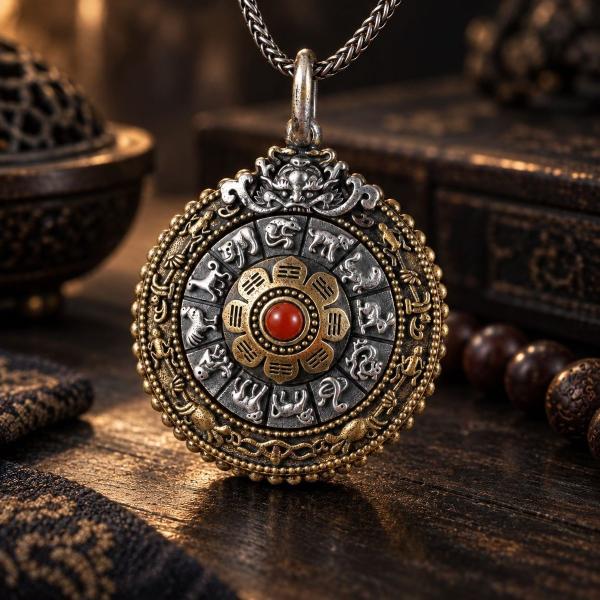
This one is nine palaces only, without the eight trigrams or the zodiac, the face a single grid inside a border. The grid lines have to be straight and evenly spaced; a small error in the casting comes out visibly crooked after polishing. The numbers use the old forms, one through nine in sequence, five at the center. The border is double: an inner line fine, an outer line slightly heavier, the gap between them even or the face looks crowded. The four corners of the grid must be true; tilt one corner and the whole plaque leans.
The hole is at the top, and the plaque turns as you walk, showing its back. That side is plain, with a small stamp at the lower edge. Some people find the turning annoying and trap the hole between two small beads, which fixes the plaque with the pattern always facing out. The stamp on the back is a small square, struck shallow, and it wears smooth with long wear. That is ordinary attrition, not a flaw.
Silver plaques are thin and do not take pressure. Keep it in a bag away from hard objects; once a corner takes a dent, the grid line is broken. Do not rush to polish the face when it tarnishes. The recessed numbers darken with time and become clearer for it. Use a dark cord, deep red or ink black. Pale colors cannot hold the weight of the face, and white cord especially floats. Worn inside clothing, the side against the skin polishes bright, which is normal enough.