


Menu
By theme
By theme

{{ variable.name }} : {{ variable.values[selectedVariantsIndex[variable_index]].name }}
Quantity:
The nine-tailed fox began as a beast, not an immortal. The Classic of Mountains and Seas records a creature on Mount Qingqiu, shaped like a fox with nine tails, its voice like a baby's, able to eat people. The same entry says that eating its flesh keeps a person from falling under evil influence. The ancients wrote good and bad in the same breath. Later commentators smoothed it over, explaining that "able to eat people" meant able to master them, not devour them. Explanations of this kind were added generation after generation, each further from the text.
Then it changed. In the legend of Yu the Great marrying a daughter of the Tushan clan, the nine-tailed white fox appears first as an omen: slow, slow the white fox, nine tails vast and full. Seeing it meant a clan was about to prosper. Later still, foxes in folk tales came to look more and more like people, and nine tails became a marker of age, more tails meaning deeper cultivation. In Tang dynasty tales of the strange, foxes mostly took the form of women. By the Qing the image had split into good and bad, and the nine-tailed was the oldest rank of all.
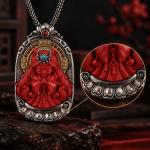
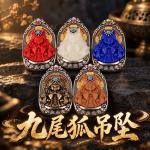
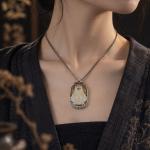
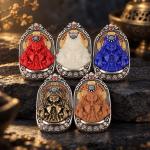
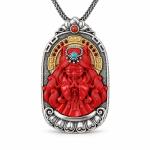
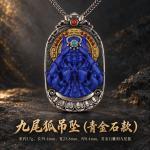
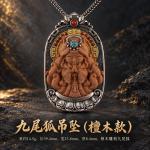
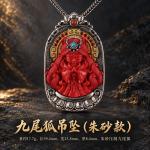
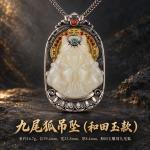
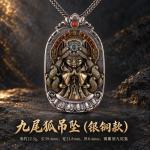
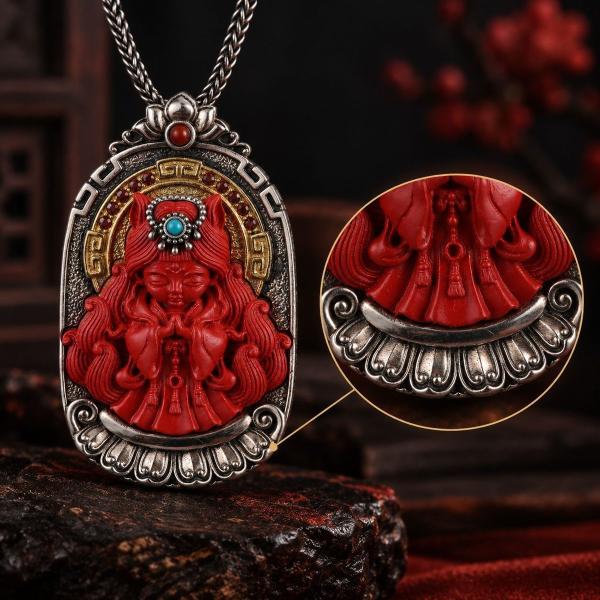
This piece is one shape with five faces. A silver frame holds an inset of another material: warm Hetian jade, dense sandalwood, lapis with its deep blue and gold flecks, cinnabar red, and one silver-copper version that is metal through and through. The same fox with a different inset changes character. Jade is quiet, cinnabar is fierce, lapis jumps most against dark clothing. The five also differ in weight: jade and lapis sit heavy in the hand, sandalwood is lightest, cinnabar falls in between. At the same size, the drape on the body is noticeably different.
The fox lies on its side, nine tails spreading behind it, one layer over another, the outermost tapering thinnest at the tip. Nine tails on one plane blur into a thicket most easily. The solution here is to leave a gap between tail and tail, the gap running all the way down, so light gets in. The tips are the thinnest part of the piece. Cinnabar is the most brittle of the five, and those tips need particular care; one knock and a corner is gone.
The inset parts dislike water. Sandalwood and cinnabar should not soak, so take the pendant off to wash your hands. Lapis and Hetian jade do not mind water but mind knocks; chip the edge of jade and the break shows white. When the silver frame tarnishes, wipe around the inset and do not let the polish on the cloth smear onto the wood. Sandalwood takes on a patina with wear, the color going toward deep red. Cinnabar's color is stable, but it fears scratches, and one white line stays on the face.