


Menu
By theme
By theme






{{ variable.name }} : {{ variable.values[selectedVariantsIndex[variable_index]].name }}
Quantity:
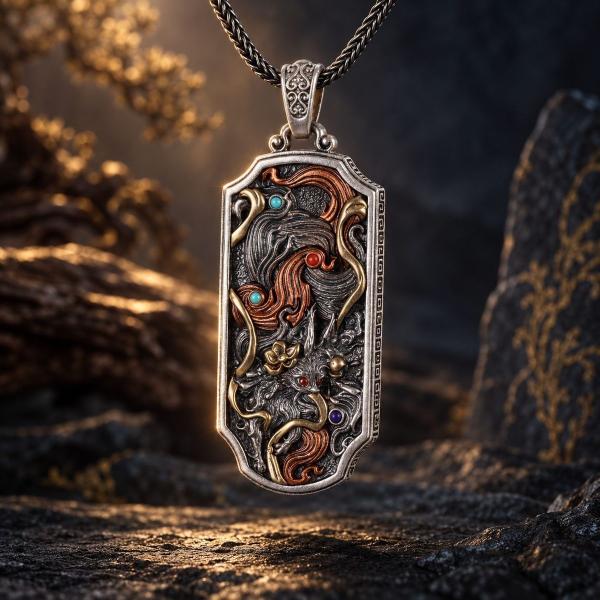
The difference between relief and sculpture in the round is the back. A piece in the round has to answer on four sides; turn it over and it is still a fox. Relief has only one face, and the back is flat, lying against clothing. So with relief all the effort goes into that small thickness at the front. Too little thickness and the face goes flat; too much and from the side it looks like a slab stuck on. The measure lies somewhere in between. A narrow border runs around the edge, holding the relief inside so the pendant does not look scattered.
The nine tails are the core of the problem. Nine in a flat row look like a fan. Stacked in three layers, each layer casting a shadow on the one behind, they gain depth. This piece divides the tails into three groups: the ones against the body shortest, the middle ones lifted, the outermost sweeping behind the shoulder with the tips flicked up. Grouped this way it reads as nine from the front and still nine from the side, so turning it does not leave you with three or five.
The fox's face is made small: the eyes are two hollow points, the nose bridge a single ridge. Once the silver is polished the raised areas are bright and the hollows dark, and when light comes at an angle the face appears. Head-on it is a field of white; turn it slightly and the modeling shows. A pendant like this works best against dark clothing. Ear, nose bridge and jaw have to be continuous in their rise and fall; break one and the face falls apart. Polishing eats small modeling, so the blank has to be cast a little high. The shadows in the tails are cut, not sanded: recesses darkened, raised areas left bright, and only then do the layers hold.
The thick part is the fox's body, the thin part the tips of the tails. Silver hates a sudden change in thickness; thin sections cool first in the mold and shrink, so the tips are made a little thicker than they look, blunt to the touch and less likely to break. The back is flat with a single loop for the cord, the hole set at center and slightly high, so the pendant lifts its head a little when hung.
Do not use too fine a cord. A relief piece has weight, and a thin chain drags it forward and face down, wasting the carving. Leather or braided cord, on the heavy side, and the pendant will stand. Silver yellows with age; that is its own color, and polishing too often flattens the shadow in the recesses. Use a slightly longer cord so the pendant sits below the chest, the curve facing out, and the layers of the tails can be seen whole. Heavy antiquing does not suit silver relief; done heavily it looks like iron.