


Menu
By theme
By theme

{{ variable.name }} : {{ variable.values[selectedVariantsIndex[variable_index]].name }}
Quantity:
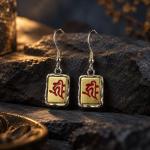
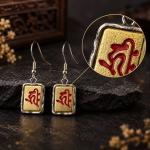
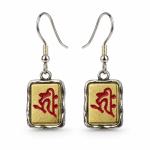
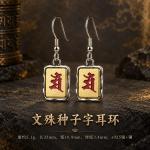
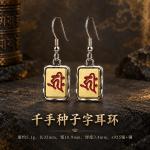
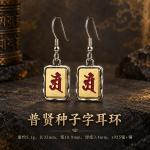
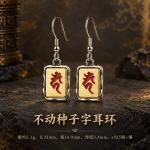
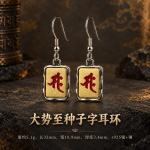
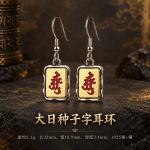
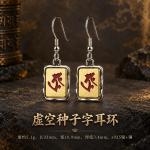
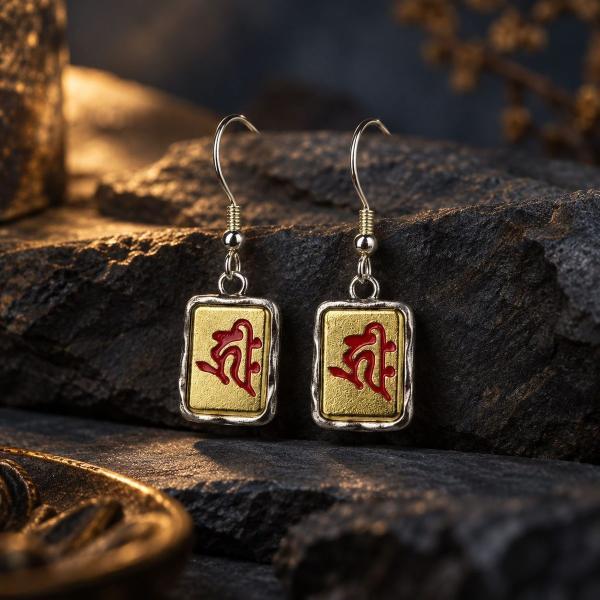
Earrings sit close to the face, and that position fixes their size. The character has to be small enough not to block the face and large enough to stay legible, and the margin between is narrow. This design sets the character on a round disc no bigger than a thumbnail, the character taking up most of the middle with a rim around it. A round disc does not catch hair, the edge is round, and the side against the lobe is chamfered. The disc is round, yet the character is laid out square, with more space left at the four corners than at the sides.
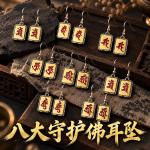
Six designs for six figures: Mahasthamaprapta, Manjushri, Vairochana, the Thousand-Armed One, Acala, Akashagarbha, one syllable each. The characters are Sanskrit, not Chinese. The stroke begins at the center, loops out and comes back, some with a bar across the top, some with a dot. The differences between the forms are slight, invisible to anyone unfamiliar and obvious at a glance to anyone who knows. All six carry the top bar, the head shared by Sanskrit letters; the difference is in the mass below and in the direction the stroke closes.
The Manjushri design is often bought as a gift for someone sitting exams; the Akashagarbha is mostly bought for oneself. Acala's character is the squarest, strokes like knife cuts. The Thousand-Armed one is the busiest, several strokes stacked together, and where the work is poor it blurs into a black mass. When choosing, lay all six out and take the form you like; the meaning can be asked about later. As a gift, Manjushri is safest because the meaning is clear. Acala is too fierce, and given to someone you do not know well it can be misread.
The hook is fine and holds by its curve, not by a back. Silver is tough; the hook opens a little with long wear and can be pressed back with the fingers, not with pliers, whose jaws leave tooth marks in the silver. Thickness matters too: too fine and it will not stay, too thick and it will not pass the piercing, and finer than a hair it breaks.
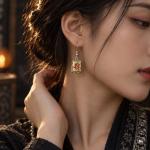
The two need not match. Some wear Manjushri on one side and Akashagarbha on the other; others rotate all six according to the day's business. Silver at the ear is rubbed by hair and darkens fast, so take them off to shower and you save a lot of polishing. Matching pairs are fine too, worn symmetrically with the characters facing out. Others see a pair, you see nothing, and what you wear is the meaning you know. Do not rush to wear them in a freshly pierced ear; silver is not heavy, but catching on hair will pull.