


Menu
By theme
By theme




{{ variable.name }} : {{ variable.values[selectedVariantsIndex[variable_index]].name }}
Quantity:
How a dragon coils on an object follows rules. A coiled dragon is not simply the body wrapped once around. The head must turn back, the whiskers lift, the four claws each take a direction, and the tail passes between the hind legs. A well-coiled dragon looks like it is moving; a poor one looks like a snake tied in a knot. The body wants three bends — neck, waist, tail — and the three must not run the same way, or it becomes a ring. The scales have to follow the bends. Where the body turns, the scales turn; reverse them and the whole dragon reads twisted.
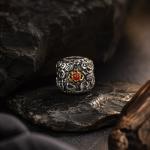
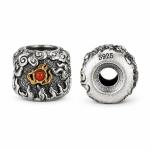
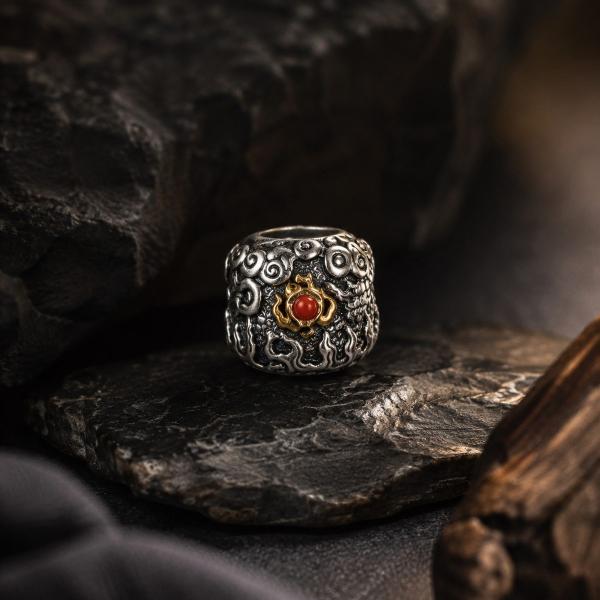
This bead is a coiled dragon with auspicious clouds. The body circles the bead once, the head at the front and a little high, mouth open, a pearl at its lips, which is the old dragon-and-pearl figure. Cloud heads roll up from under the body, one over another, and the cloud tails gather at the back, which is exactly where the cord goes. The pearl is a separate piece, slightly larger than the dragon's eye, half sunk in the mouth so it looks held rather than glued on. There are only two whiskers, drifting back from the corners of the mouth and lying over the cloud heads; they are the thinnest part of the whole piece.
Auspicious clouds come in several kinds. The curled cloud spirals inward; the ruyi cloud has a hook at its head; the lingzhi cloud has layered petals at the edge. This bead uses the ruyi cloud, with a fat head and a fine foot, which sits well against the lean strength of the dragon instead of fighting it. The number of layers matters too: one is too thin, three too thick, so two cloud heads stacked is right and a third shows only an edge.
As a spacer, one is enough: below the top bead, or on either side of the Buddha head. The scales are pressed one by one; pressed shallow they vanish, pressed deep they collect dirt. On the wrist the black in the seams of the scales grows more visible, which is silver oxidizing, and there is no need to pick at it with a needle. The bore has to be true; off by a little and the whole bead sits crooked, the dragon's head turns with it, and the strand looks wrong. One such spacer to a strand. Do not put two coiled dragons on one strand, two dragons fighting for one position where neither shows.
The bore passes through the middle of the body, and the clouds on either side do not block the cord. Dark beads are the steadiest pairing; the white of the dragon only floats against a dark ground. On an all-white strand the dragon dissolves into it. Silver white and bead white are not the same white, and pairing them depends on the difference in texture, not on color.