


Menu
By theme
By theme




{{ variable.name }} : {{ variable.values[selectedVariantsIndex[variable_index]].name }}
Quantity:
dZi is a heavy matter in Tibet. A true dZi is agate with the pattern dyed into the stone: one eye, two eyes, nine eyes, tiger tooth, lotus, treasure vase, line bead, each with its own name. Old beads can trade for cattle and sheep in Tibet and pass down as heirlooms. The prices are high and true from false is hard to tell. The pattern is not carved but dyed after whitening, the color going into the stone so it cannot be worn off, which is one of the tests.
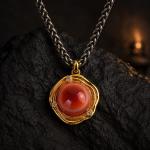
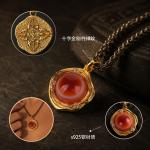
This piece is the shape of a dZi, not a dZi. A cast silver body, thick at the middle and tapering at both ends, strung on a cord, with a swirl pattern on the surface, ring inside ring, turning from left to right. Two versions, white and red: the white is silver in its own color with antiquing, the red has cinnabar color filled into the grooves. Both the same size, the white plainer and the red brighter, and only side by side do they read as a pair.
In the dZi family the swirl is closer to a variant of the eye. The eye pattern spirals inward to a point at the center; the swirl stretches that point out into a spiral. Read from different directions it means different things. Some see an eye, some see the pattern of flowing water. In Tibet the eye is a mark of protection, and the more eyes the higher the price. Silver dZi are not graded by eye count but by pattern, and the swirl is one of the lines. The swirl starts at the side of the bead and closes on the opposite side, a full turn, with the join invisible.
A bead-shaped pendant is simple to string: one cord, one knot, no fittings. The knot goes above the bead with a little slack so the bead can turn on the cord. Some people find the turning annoying and add a small spacer bead to hold it, keeping the pattern always facing out. Cotton or leather cord both work; nylon is slippery and the knot comes undone, and the end should be singed closed rather than left frayed. The red and the white can be paired, one dark and one light, on the same cord.
A silver dZi does not mind water but minds knocks. The body is thick at the middle, which is what hits the floor first, and the hollows there get knocked flat. The red version's color sits in the grooves, so do not clean it in an ultrasonic bath. One run and a layer comes off. When the silver tarnishes the recessed pattern darkens first, which is part of the antiquing and no reason to polish it all white. Do not shower in it, since water collects in the filled grooves.