


Menu
By theme
By theme

{{ variable.name }} : {{ variable.values[selectedVariantsIndex[variable_index]].name }}
Quantity:
Wenchang began as stars. Six stars in front of the Big Dipper — Shangjiang, Cijiang, Guixiang, Siming, Sizhong, Silu — together called the Wenchang palace, governing literary fortune and official rank. Stars are distant, and in time an earthly image appeared: the local god of Zitong was brought up and merged with Wenchang into a single figure, Wenchang Dijun. The Zitong god was originally surnamed Zhang. Tradition says he held office in the Jin dynasty and, after dying in battle, was given a shrine by the local people, and the offerings never stopped.
In the examination era, scholars went to him before a test. On the offering table stood a brush, an inkstick and a sheet of red paper with one's own name written on it; after the exam, one came back to fulfill the vow. Every place had a Wenchang pavilion or palace, usually built on high ground in the city or beside the Confucian school. The pavilion was often three stories, six- or eight-sided. Climb it and you see half the city, and scholars went up to sit before an exam, for the quiet as much as anything. There was no meat in the offerings: a plate of cakes and three sticks of incense is enough. What counts is a quiet mind, not display.
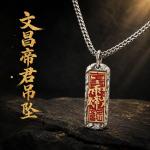
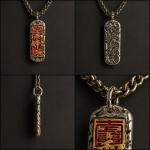
In sculpture Wenchang Dijun is dressed as a civil official, in a futou cap and a round-collared robe, usually holding a ruyi or a scroll, with two attendants, one holding a seal and one a brush. This piece takes only the half figure: crown, beard and robe collar in three layers, the scroll in his hand half unrolled. The two tails of the futou hang back, which is a civil official's daily dress. Military officers wear helmets, monks and priests wear crowns, and the head tells you at once which line a figure belongs to.
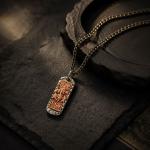
The silver face is kept plain. Only four lines of drapery are cut, running from the shoulder down and stopping at the waist. More looks fussy; for a scholar's image, plainer is right. The ridges on the crown are two fine raised lines, visible only when light rakes across. The overlap of the collar has to be clear, right side over left; reversed, it stops being Chinese. The hem is gathered at the waist and not carried through. The half figure breaks off there, and the break is polished into an arc.
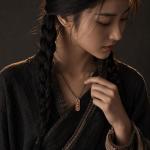
It works as a gift for a child who is studying, or worn before an exam of one's own. Use a cool cord, green, blue or moon white, rather than red. Silver darkens with wear; when wiping, keep away from the crevices of the scroll, where the black is there to give the roll its layers. It can also hang on the wall above a desk, the cord a little longer and the pendant at eye level. Worn against the body in summer, when there is more sweat, rinse it in clean water every few days.