


Menu
By theme
By theme



{{ variable.name }} : {{ variable.values[selectedVariantsIndex[variable_index]].name }}
Quantity:
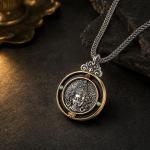
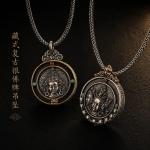
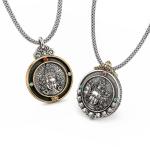
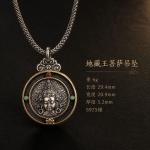
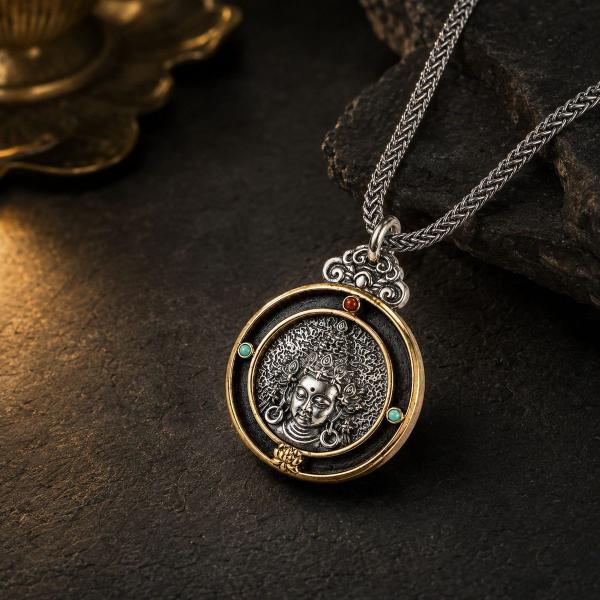
These two in one design are two roads. Ksitigarbha looks after the lower end, Marici the end that is in the light; one is heavy, one is fast, and together they split protection into two faces. One design, two versions, and you have to choose, since both cannot be cut into one piece of silver: squeeze two figures into a small piece and the features blur. Decide which one you want before buying. They mean different things, and wearing them mixed up is hard to explain.
Ksitigarbha's name comes from the title of a sutra: patient and unmoving as the great earth, meditative and profound as a secret treasury. His image is usually monastic, a staff in one hand and a jewel in the other; the staff breaks open the gates of hell and the jewel illuminates the dark. In China the figure is usually seated, in a monk's robe with a shaved head, unlike the beaded crowns of other bodhisattvas, because he appears in monk's form. The staff head has four prongs with three rings on each, twelve rings in all. The number has a basis in the discipline, and in a small piece only the idea is kept.
Marici is a transliteration of the Sanskrit, meaning the shimmer of heat, that wavering layer of light on the ground at sunrise. In sutras she is a hidden protector: enemies cannot see her, and she sees them. Her image often has three faces and eight arms, riding a pig or traveling in a cart drawn by seven pigs. In Daoism there is a Dipper Mother whose appearance and office are close to hers, and the two are often set side by side. Hidden protection takes the logic of the heat shimmer: seeming to be there, and not there when you come close.
The two are made separately. Ksitigarbha's staff is fine, the rings hanging one after another with gaps between them, which is where casting most easily fuses them into a single strip. Marici's eight arms open like the ribs of a fan, and the space between arm and arm has to be even; crowded, it becomes a slab. Ksitigarbha's jewel is round and held in the hand, and a gap has to be left between jewel and hand, or the two become one lump.
Which to choose depends on the person. Someone who has lost an elder in the family takes Ksitigarbha; someone who travels often and walks at night takes Marici. Wearing both is possible, one on each side, with no need to rank them. Silver white suits both. Ksitigarbha's robe can be left darker and Marici's halo brighter, and the one dark and one bright is what tells them apart when they hang together.