


Menu
By theme
By theme



{{ variable.name }} : {{ variable.values[selectedVariantsIndex[variable_index]].name }}
Quantity:
The ruyi was not originally an ornament. It was a back scratcher, a clawed staff for the places a hand could not reach, the end shaped like fingers. Later the claw became a lingzhi head or a cloud head, the scratching use fell away, and it became something to hold in the hand. Finer ones were made of jade or sandalwood, inlaid with gold and silver. The head grew larger and the shaft thinner, and by the Qing a single ruyi could carry several kinds of inlay, long after it had stopped being for scratching. The shaft often carries a carved cord pattern, imitating binding, so the hand does not slip.
The lotus appears on objects even earlier. Upturned lotus, downturned lotus, the number of petal layers: the rules were set by sculpture bases. Petals come single or double, tips pointed or round, and one look at the petals tells you which tradition a lotus belongs to. The form varies by region, with petals from eight to sixteen, depending on the place and the habit of the workshop.
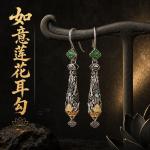
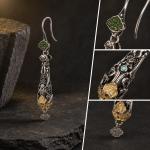
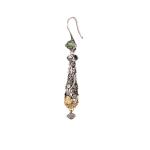
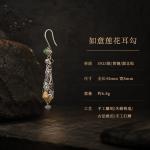
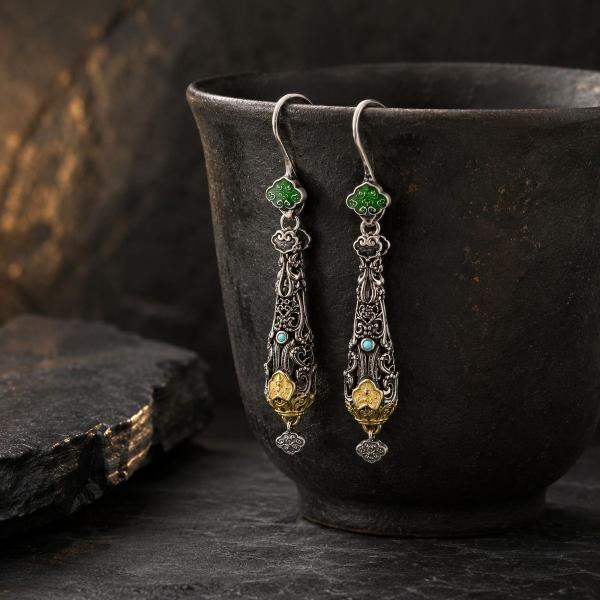
This pair is ear hooks: ruyi head above, lotus below, joined by a thin shaft. The ruyi head is lingzhi-shaped with three lobes, the middle one largest; the lotus is upturned with five petals, the tips slightly rounded rather than pointed. There is no solder joint between the two; it is cast in one piece, and the thin shaft is the part most likely to break, so it is made thicker than it looks. The three lobes are set at different angles, one opening and one closing, so the head looks alive. The ruyi head is large and the lotus small; reversed, it would be top-heavy and would tip forward on the ear.
An ear hook needs no back; it holds by the curve of the hook. Once through, it drops a little with the weight below the lobe, swinging as you walk but not falling out. If your piercing is loose, choose a longer hook, since a short one slips out. The end of the hook finishes in a small round bead that does not scratch behind the ear, and that bead is ground, not cast.
Silver hooks are soft and break if bent over and over. Put them in from directly behind the piercing, not at an angle. Store the pair in one compartment, not mixed with studs, since a hook tip caught in something else deforms easily. A silver hook softens with long wear; when it does, replace the pair rather than pinching it, because by the third pinch the spot goes white and cracks. The wire is fine and the tip wears round first, which is when it starts to slip. Hang them up when not worn; do not press them to the bottom of a jewelry box.