


Menu
By theme
By theme

{{ variable.name }} : {{ variable.values[selectedVariantsIndex[variable_index]].name }}
Quantity:
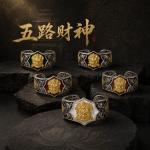
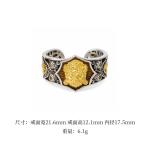
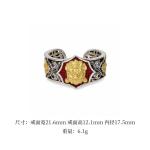
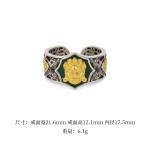
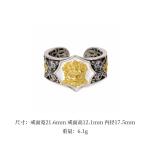
The Tibetan wealth gods are a group of five families: yellow, white, red, green and black. The five colors match the five directions and the five elements. Yellow sits at the center, the principal seat, which is why the yellow one is the most common and the most widely recognized. The five-family scheme is well developed in the Tibetan wealth deity system, each family with its own body color and implements.
Yellow Jambhala is seated in half lotus, belly large, a wish-fulfilling jewel in the right hand and a mongoose in the left, jewels spilling from its mouth to roll at his feet. White Jambhala is white-bodied with a quieter face; tradition says he came from a tear of Avalokiteshvara. Red Jambhala is often shown in union, Green is green-bodied and Black is black-bodied; the last three are rarely seen in China proper but are often offered together in Tibet. Some accounts put Black Jambhala first among the five, saying he does not sort rich from poor and gives to whoever comes. The mongoose is the surest mark of Yellow Jambhala, its tail curled around the god's wrist. The belly carries the weight of the whole figure; made flat, the figure goes light.
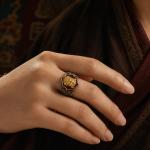
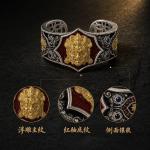
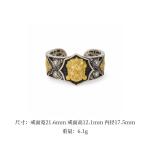
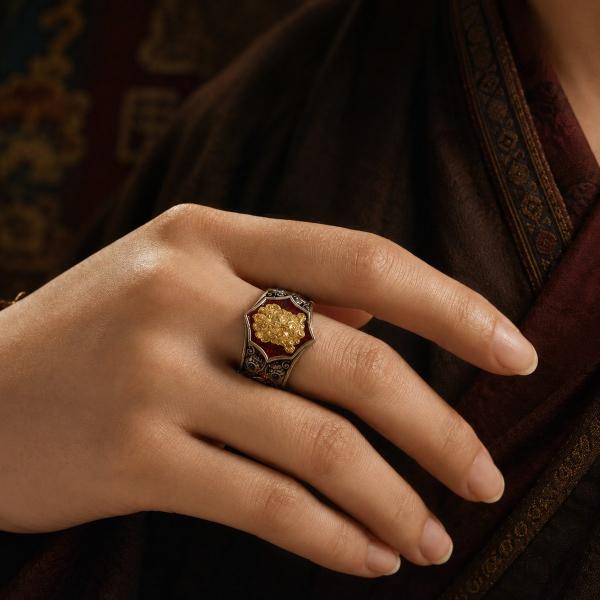
The ring takes the upper half of the seated figure: crown, face, chest and the jewel in the hand, four layers. The opening is at the back with a margin left on both sides; part it, slip it on, close it. The thickness at the opening matters most: thin and it loosens, thick and it will not bend. The face of the ring is curved, not flat, and the curve lies against the back of the finger, taking the shape of the hand with wear and sitting better the longer it is worn. The face has to be wide, since narrow will not hold the features and wide gets in the way of bending the finger. The measure is in between.
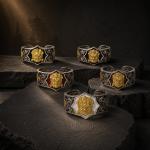
Set the five side by side and the colors separate clearly: the yellow one leans gold, the white one plain, the red the brightest, the green the coldest, the black held lowest. Choose by eye; there is no need to work out which one manages what first. Yellow and black are picked most often, one for steadiness and one for speed, and the other three are mostly collected to complete the set.
An open ring is not made to be worn for years without taking it off. Silver fatigues, the two sides of the opening take load back and forth, and fine lines appear in time. Take it off to shower and to sleep and the ring lasts much longer. When the silver tarnishes, do not dig at the crevices in the crown; dug out, they go white. The silver setting surrounds the edge of the figure, and that rim is narrow, so it collapses easily in polishing. Collapsed, the face spills outward and looks fat. Rotate the five, a month each, and you will not tire of them.