


Menu
By theme
By theme

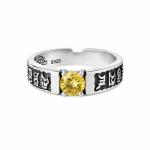
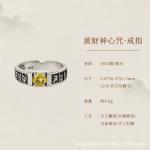
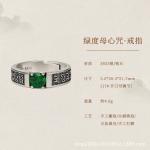
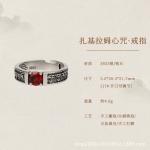
{{ variable.name }} : {{ variable.values[selectedVariantsIndex[variable_index]].name }}
Quantity:
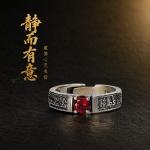
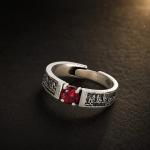
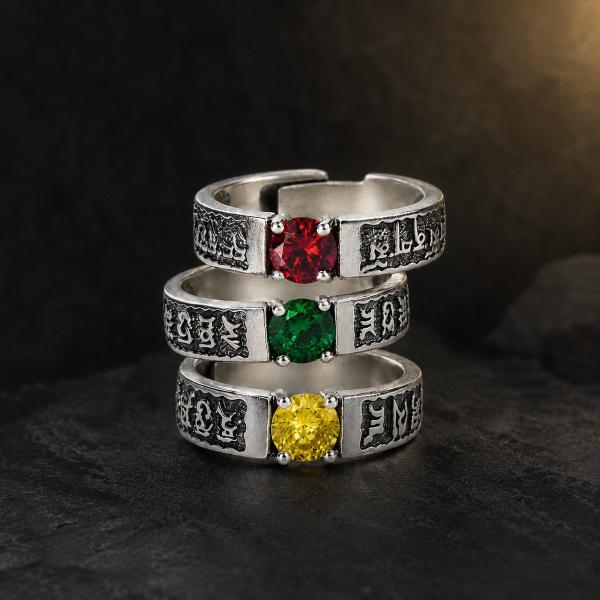
Tibetans use a mantra as sound, not as text. A heart mantra is short, a few syllables to a round, and the person reciting it does not parse the meaning; the repetition is the point. Engraved on a ring, the same logic applies. The characters have to be small, they have to run all the way around and meet again, and no stroke can break off halfway. Break one and the recitation snags there. The band sits against skin, so the cutting cannot be deep, because deep cutting rubs, and it cannot be so shallow that the strokes stop reading. At that point you may as well not have engraved it.
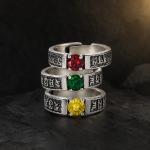
Three versions: Green Tara, Zhajiram, and Yellow Jambhala. Green Tara's mantra is the shortest and the most often recited in Tibet, and hers is the swift rescue from sudden trouble. Zhajiram is the protector of Zhaji Temple in Lhasa, black-faced with her tongue out, and folk worshippers bring her their requests for money. Yellow Jambhala heads the five Jambhalas, yellow in body colour, a wish-fulfilling jewel in his right hand, a jewel-spitting mongoose tucked under his left arm, belly round, seated in half lotus. Three different origins, three different tempers. Which one you pick depends on which one you know best.
The Yellow Jambhala version has the hardest hands to make. The mongoose is pressed into the crook of the arm with its head facing out and its tail tucked behind the elbow, barely the length of a grain of rice, and it still has to read as a mongoose and not as a cat. Green Tara's hand runs the other way. The left hand rolls a blue lotus between the fingers, the stem winding past them, and whether the winding is right is settled by whether the flower opens at ear height. None of this shows in a photograph. Turn the piece in raking light and it declares itself. The fingers are thin, and in casting the gaps between them tend to fuse; the chaser opens them again afterwards.
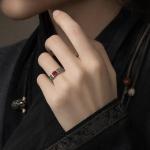
An open band is the easy solution and also a fussy one. It fits fingers from slim to thick, so nobody with heavy knuckles has to force it on, and you can give it without asking for a size first, which is its most practical virtue. The price is repeated bending. Silver is ductile: bend it three times a day and within a month it has loosened, and once it loosens the face goes crooked, and once crooked it does not bend back. Leave it alone once it is on. Take it off for washing your hands or lifting something heavy, and when you take it off, hold the band at the sides rather than at the gap.
The face is kept narrow, so the ring of characters is crowded and the cutting shallow. Shallow has its advantages: it does not catch on a sweater and does not dig into the webbing between the fingers. The disadvantage is wear, since anyone who writes or types all day will see the strokes blur within six months. As silver darkens, the recesses go black first and the lettering reads more clearly; there is no need to hurry to polish it then. All three versions sell at one price, and the choice should not be made on which one is more efficacious. A mantra is recited, not wished upon. Worn on the hand it is closer to a mark. Before it goes back into the pouch, press it with a dry cloth and let the cloth take up the sweat.