


Menu
By theme
By theme












{{ variable.name }} : {{ variable.values[selectedVariantsIndex[variable_index]].name }}
Quantity:
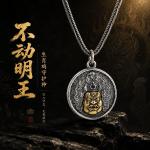
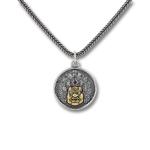
A round plaque with six faces swapped onto it sounds awkward, and yet it works. A circle has no front and no back: turn it over and it is still a circle, and the pendant can swing half a turn on the chest without looking off-centre. A square plaque demands alignment, and a degree out of true shows immediately. The circle forgives far more. The diameter is small, so six faces are crowded onto a surface the size of a coin, and that is achieved by taking strokes away rather than by making the faces bigger.
The six versions each hold one office. Amitabha is the Buddha of the Western Pure Land, who made forty-eight vows to carry beings across. Mahasthamaprapta and Avalokiteshvara stand at his left and right, and together the three are called the Three Saints of the West. Acala is the wrathful command form of Mahavairocana, sword in the right hand, lasso in the left, a ring of fire behind him. Akashagarbha governs merit and wisdom and holds a wish-fulfilling jewel. Manjushri rides a blue lion with a sword and a sutra scroll. Samantabhadra rides a six-tusked white elephant and is the body of the ten great vows. Vow, practice, insight, merit, protection, deliverance: six places, each with its occupant. All six follow the forms common in clay sculpture. Nothing has been cleverly reinterpreted, because a reinterpretation would not be recognised.
Wearers often ask which one to choose. My answer is to look first at what you lack, not at what you want to ask for. Someone scattered and inclined to put things off is better matched to Samantabhadra, whose subject is practice. Someone whose mind is noisy and cannot settle on a decision is better matched to Manjushri, whose subject is cutting through. Someone with a house full of demands and other people pushing them along is better matched to Acala, who does not move. There is nothing mystical in this; it is only laying out the six temperaments so you can find your own place among them.
On all six faces the brows and eyes are cut shallow. Amitabha's eyes are lowered, and so are Mahasthamaprapta's; the difference is the treasure vase in Mahasthamaprapta's crown, its mouth turned up. That vase is how he is identified, and made too small it disappears, and once it disappears the two cannot be told apart. Acala's glare is the easiest of the six to read: the brow ridge sits low, little of the white of the eye is left showing, the teeth are set on the lower lip. The rim of the plaque has to be evenly round. Cast it a fraction thin and the polishing collapses it into a chipped edge, so this one keeps a little thickness and feels blunt under the thumb.
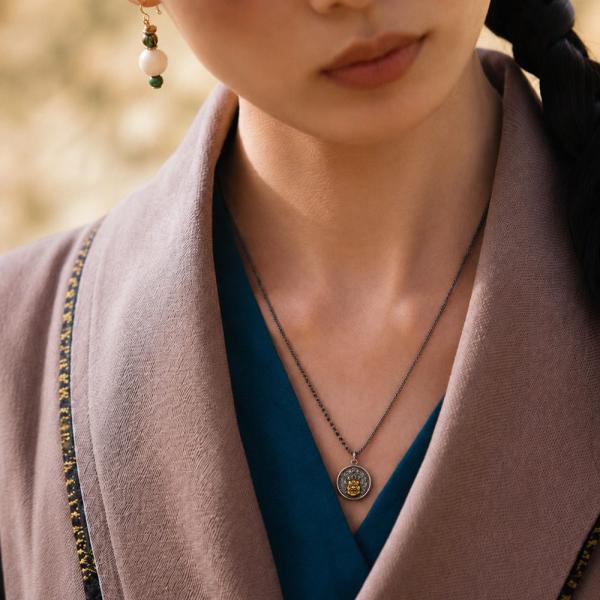
The back is flat and does not press into the skin. The relief is low, so the pendant does not show as a bulge under clothing and is fine with a thin shirt. Use a dark cord; black and deep red are both safe. A chain works too, but a fine chain makes a round plaque look top-heavy, and a plain chain needs to be a heavier gauge to hold it. Silver darkens with wear, and the shadows that collect in the recesses look painted on, better than the piece did when it was new. Do not take a polishing cloth across the whole face; polish it flat and that effect is gone.