


Menu
By theme
By theme

{{ variable.name }} : {{ variable.values[selectedVariantsIndex[variable_index]].name }}
Quantity:
A conch shell only counts if its spiral turns to the right. Left-turning shells are rare in nature, and the ones that are found are kept as ornaments rather than used as ritual implements. The right-turning white conch is called dungkar in Tibet and stands fifth among the Eight Auspicious Symbols, after the parasol, the fish, the vase and the lotus, and before the endless knot, the victory banner and the wheel. Its note carries a long way, and monasteries use it to call people together and to mark the hours. It is not an instrument. It is a signal.
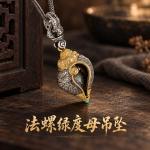
This piece sets the conch and Green Tara together. Tara sits on the body of the shell with her right foot stepping out, which is her swiftness in rescue. Her left hand turns a blue lotus, the stem winding from between her fingers to behind her shoulder; her right hand is in the gesture of granting wishes, palm turned out, fingers hanging naturally. Green Tara's body colour is green, she saves from the eight dangers, and in Tibet a family will often send a woman setting out on a long journey with one of her images to carry.
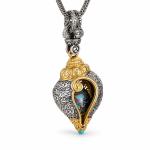
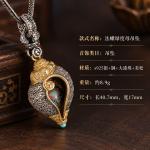
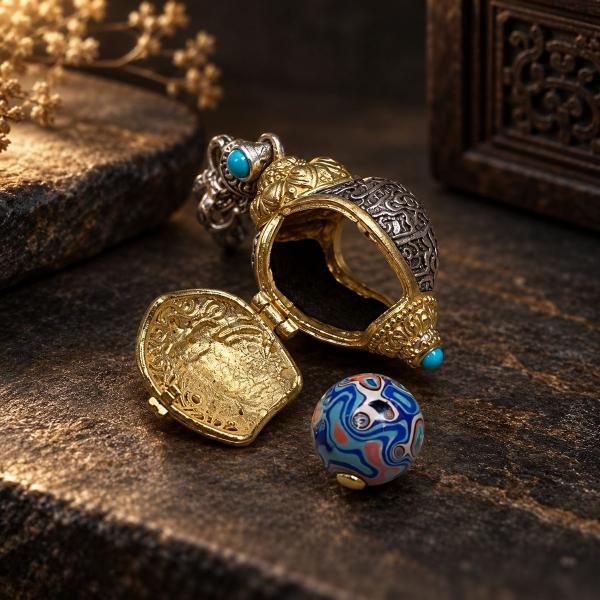
The body of the conch is harder to make than a face. The spiral has to be pushed up ring by ring at an even spacing and closed at the back, so that no seam shows from the front. Cast pieces clog most easily at the mouth and turn into a lump that no longer reads as a shell. This one has an open mouth: you can see the inner lip, and where the light enters there is a small dark pocket that gives the depth away. The lip is also the thinnest part. A fraction thicker and it goes dull; a fraction thinner and there is a gap. The tip tapers sharply and tends to lose a small piece in casting, and a missing piece has to be built back up.
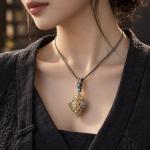
Tara seated on a conch presents one difficulty: the shell is round, so the seat is not stable. Older versions add a lotus base to the back of the shell to flatten the contact; this one keeps the base but presses it very thin, so from a distance it looks like a ridge running across the shell and only close up is it recognisable as petals. Where the pendant hangs matters as well. It is not a small piece, and it sits most steadily at the centre of the chest. A fine chain will be dragged down by it, so use a heavier plain chain, or a cord with the knot hidden behind the pendant where it cannot be seen from the front.
Tara's face has to be made still. The eyes are slightly lowered, and the corners of the mouth are neither pulled in nor lifted; overdo it and she is smiling, and a smile is wrong here. The face on this piece is no bigger than a thumbnail, and the features are carried by three shallow grooves, so the brows and eyes only separate at close range and from a distance the whole is a quiet outline. In summer, sweat against the skin darkens silver quickly. At home, press it dry with a soft cloth before putting it away, and do not soak the whole piece, because soaking leaves pale marks in the crevices. The face is small, so the polishing cloth has to be twisted to a point to reach down beside the bridge of the nose.