


Menu
By theme
By theme





{{ variable.name }} : {{ variable.values[selectedVariantsIndex[variable_index]].name }}
Quantity:
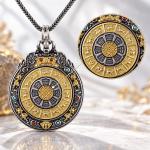
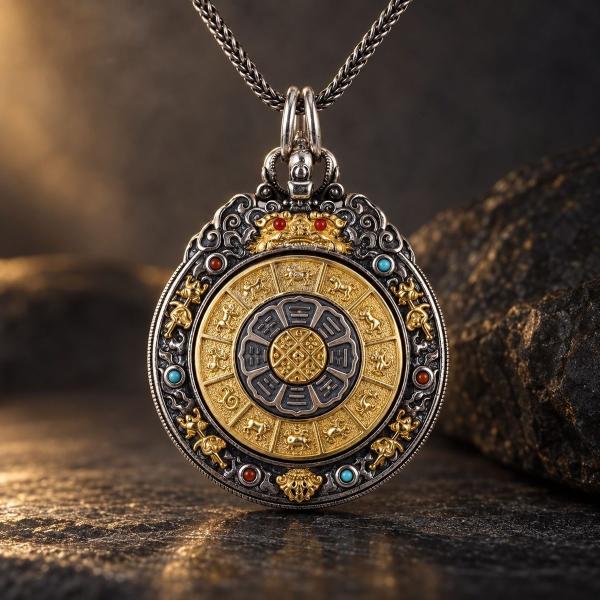
The most familiar nine-palace bagua plaque is the kind that turns. This one does not. The face is fixed, and three layers are pressed onto it together: the nine palaces, the bagua, and the twelve zodiac animals. What you read is the arrangement, not the feel of a spinning disc. Without an axle the back can be left flat, so it sits comfortably against the chest, and the thickness comes down by half. A single hole at the top takes the cord, drilled slightly above centre so the plaque hangs straight instead of listing to one side.
The numbers of the nine palaces follow the Luoshu square: nine at the top and one at the foot, three to the left and seven to the right, two and four on the shoulders, six and eight at the feet, five in the middle cell. Every row, every column and both diagonals add up to fifteen. That property was already being used in the Han dynasty to work out directions, and it served for deploying troops, siting houses and dividing provinces. Around it runs a ring of bagua, Qian to the south and Kun to the north, which is the Earlier Heaven arrangement. Outside that is a ring of the twelve zodiac animals, one to a year, so the cell tells you which year you are looking at. Five holds the centre of the grid, and the eight numbers arranged around it each own a direction. The directions do not move.
In Tibet this kind of diagram is called a sipaho, which means a chart of the world. It began not as a protective charm but as a tool of calendrical and divinatory calculation, used for counting days, fixing directions and checking which forces were in conflict, and only later was it made into a plaque to hang at the belt. That is why the surface is all symbols: no faces, no narrative. In this it differs from a Buddha image. It is not worshipped. It is used.
The three layers have to stay distinct. The nine palaces sit innermost, with the heaviest lines. The bagua come next, the yao drawn in threes, and where a line is broken it has to be broken cleanly, with no thread of silver left joining the halves. The zodiac sits outermost, the animals made small, reduced to an outline that can still be identified: the horns of the ox and the horse, the tail of the rat, all of them have to survive. Crowd three layers together without varying the weight of the line and the result is a knot of hemp. The zodiac runs from the rat, twelve years to the circle, and older people read it faster than they read numbers.
The cutting on this piece is deep, and the recesses have been left dark. Dark is not the same as dirty: the recess is pressed down so the raised line stands up. The test of whether it has been done right is whether the nine small squares of the grid are the same size and whether their corners are true; a little out and the whole grid looks skewed. Do not choose too pale a cord for it. Off-white and light grey cannot hold the plaque. Dark brown, ink black and deep red all work. It looks better worn outside the clothing than tucked into a collar, since the plaque was made to be seen. Silver dims quickly against sweat, and dust gathers in the cells; brush it dry with a soft brush rather than washing it.