


Menu
By theme
By theme



{{ variable.name }} : {{ variable.values[selectedVariantsIndex[variable_index]].name }}
Quantity:
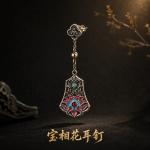
The baoxiang flower is not a flower. There is no plant it corresponds to. Craftsmen of the Sui and Tang took the lotus, the peony and the chrysanthemum apart, took their petals and reassembled them into a symmetrical bloom of nested layers, and the rosettes on the coffered ceilings at Dunhuang and the chasing on gold and silver vessels all follow that line. What the design wants is fullness, not botanical likeness. The arc of a petal is rounder than any real petal, and each layer has to hold the one beneath it.
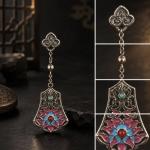
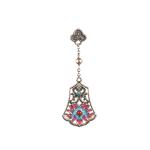
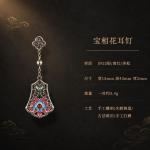
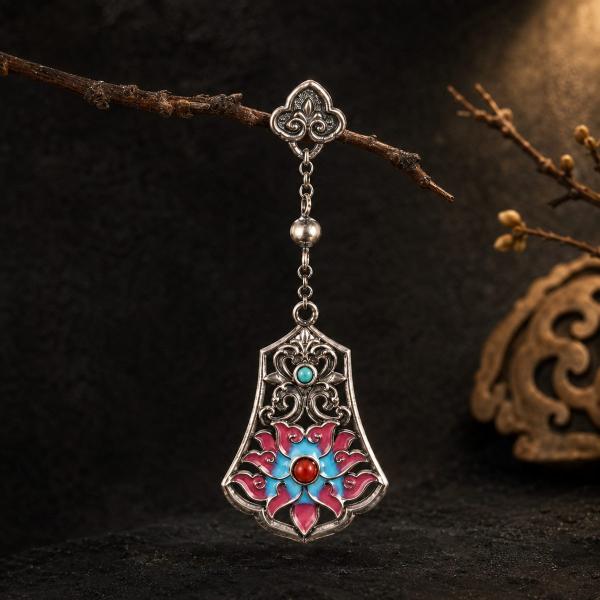
An earring forces subtraction. The baoxiang flowers on mural walls carry five or six layers; shrunk to the size of an earlobe, that many layers smear into a button. This pair keeps three. There is a bead at the centre, two rings of petals around it, and eight petals in the outer ring, their tips slightly pointed rather than rounded off. Eight is a steady number: from any angle the flower is symmetrical. The bead is not polished bright but left a little matte, so that the centre does not compete with the petals around it.
The depth of the petals rests on two lines. The outer ring is pressed low and the inner ring high, with a sunken line between them; light comes in at an angle and the border between the rings appears. That line is the real test of the hand. A fraction deeper and it breaks through, a fraction shallower and it cannot be seen, and it is cut in a single pass with one chisel. An earring sits on the lobe, which is the most active place on the body: hair sweeps across it, a phone is pressed against it, and all of that wears at the metal. So the back plate has to be flat and the post a little thicker than usual. A thin post shifts about in the piercing, and in time the earring hangs lower.
S925 silver is cool in tone, which suits a dense pattern like this one: press the darks and the layers of petals come forward, while polishing it too bright leaves nothing at a distance but a patch of white glare. The hardness of silver comes from the alloy. Fine silver on its own is too soft to hold the edge of a thin petal, and that is the reason for mixing it. The post on this pair is soldered to the back of the flower centre, with the joint hidden beneath the bead, so nothing shows from the front. The rims of the petals are made thin enough to let a little light pass, which gives depth from a distance.
Dry the piercing before you put them on. A silver post meeting damp and sweat will leave a dark ring inside the hole within two days, and it does not wash out; you wait for it to fade. When they are not being worn, keep them in their own small pouch rather than heaped in a compartment with other earrings, because petal tips bend more easily than anything else here. If one does bend, do not reach for pliers: pad it with a cloth and push it back slowly with the pad of a finger. Keep toner and perfume off them, since alcohol turns the surface of the silver chalky. The posts stiffen with use, and a pass with a polishing cloth is enough to free them.