


Menu
By theme
By theme

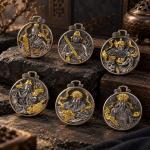
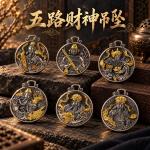
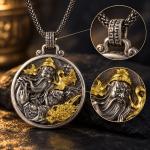

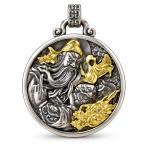
{{ variable.name }} : {{ variable.values[selectedVariantsIndex[variable_index]].name }}
Quantity:
The five wealth gods are not five figures worshipped together so much as one figure for each of the five directions. Bi Gan holds the east, Guan Yu the west, Chai Rong the south, Zhao Gongming the north, and the centre belongs to the one who disperses wealth. Which of them you prayed to depended on which direction your trade ran in, and that was the rule in the old shops: people moving goods prayed to the west, shopkeepers to the centre. Only all five together make up the five directions, though a single figure is common enough too. A small shop needs one.
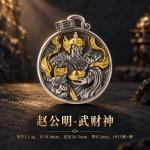
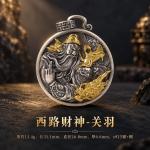
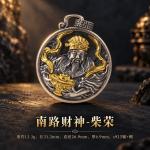
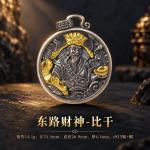
Bi Gan had no heart, and therefore no self-interest, which is why the east is his. Guan Yu put righteousness first, and merchants put trust first, so the west is his. Chai Rong pushed a cart and sold umbrellas when he was young, travelling north and south, and the south claims him. Zhao Gongming, black of face and heavy of beard, rides a black tiger and carries an iron whip; he is the martial wealth god, and the north is his. There is also a version of General Li Cheng, which belongs to the local usage of one place; it is enough to know he exists; no need to force him into the five. The centre figure carries no name at all, only a gold ingot, and serves as a general seat.
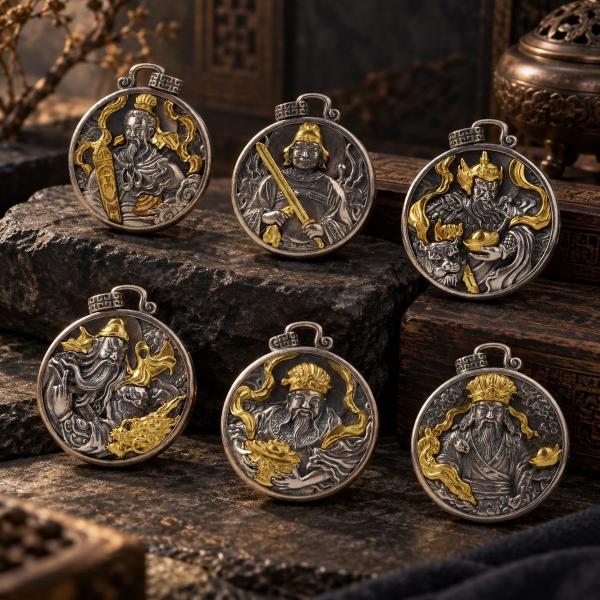
The six versions differ in what the figure holds and what he wears on his head. Zhao Gongming carries an iron whip whose segments can be counted one by one. Guan Yu strokes his beard with one hand and rests the other on his knee, and carries no blade. Bi Gan holds a hu tablet, and the tablet is straight. Chai Rong pushes a cart, and only half a wheel shown. Read them by these things first. The faces are all square with long beards, and the faces alone will not separate them. Zhao Gongming's black tiger is made as half a tiger, with the other half hidden behind the robe, saving work without looking wrong.
Composition on a round plaque is difficult because it has to be even. One main figure at the centre, space left around it, cloud scrolls pressed into the four corners so that the weight does not drift. Small figures suffer most from distorted proportion: a large head on a short body looks clumsy, a small head on a long body looks empty. The head-to-body ratio here follows the convention of clay sculpture, the shoulders wider than the waist, the seated pose steady, and only two or three folds in the robe, since more than that becomes a tangle. A single hole in the back, and once the cord is through, the knot cannot be seen from the front.
The relief is low, so the modelling only appears when light comes from the side. Worn over dark clothing, the face of the plaque reads clearly; over pale clothing the silver and the cloth sit at the same value and the outline weakens. Not a fault in the piece; the nature of silver. The martial versions carry weapons, and their edges are keener than the civil officials', so with small children, mind the face when you lift them. Silver is soft: knock the segments of the iron whip and they dent, and a dent is something you live with. Keep perfume away from it, because alcohol raises a white haze on the surface, and do not brush the face with toothpaste, since the grit will flatten the cloud scrolls.