


Menu
By theme
By theme





{{ variable.name }} : {{ variable.values[selectedVariantsIndex[variable_index]].name }}
Quantity:
Old books give two answers to where the Dragon Gate is: Hejin in Shanxi, and Hancheng in Shaanxi, the two facing each other across the river. The Yellow River narrows at this point and the current runs hard. Carp swim upstream against it, and the ones that clear the drop turn into dragons. That is recorded in the Sanqin Ji, and from there it passed into the primers and became a figure for a scholar going up to the examinations. The bank along that stretch is steep, and in winter, when the water runs clear, you can see the fish circling below the dam. The two places face each other over the water and each tells its own version, and neither can produce an earlier authority than the other.
In the Tang dynasty, a man who had passed the highest examination attended a banquet called the burning tail, and the name comes from the moment in the transformation when the fish's tail is burned away by heavenly fire. So the motif was never confined to jewellery: it appears on door lintels, on chests and trunks, in New Year prints, and what all of them are asking for is the two words, passing the gate. Set in jewellery the meaning sits closer to the skin, and the person wearing it knows which gate they are the one trying to cross.
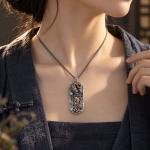
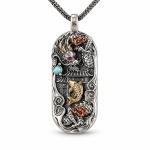
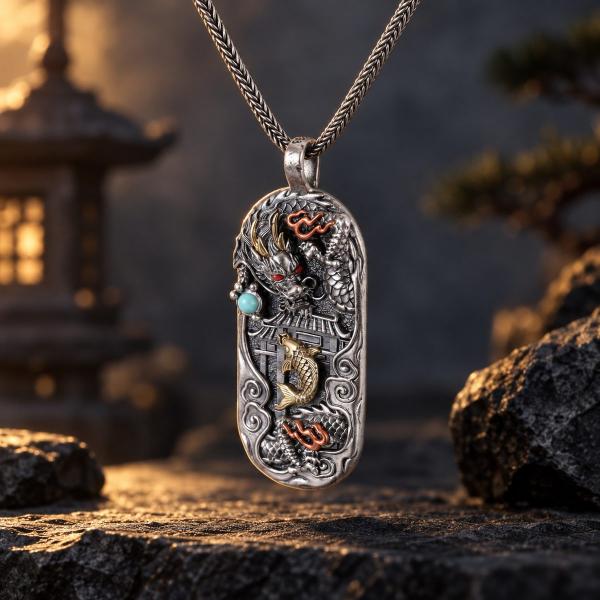
The pendant takes the instant when the fish's body folds upward: tail flung to the left, head toward the upper right, the body twisted into a single arc with the scales following the arc, each one overlapping the next. The hardest part of this pose in metal is the tail fin. The fin rays are thin and tend to come up short in casting, and one missing ray shows immediately. On this piece the rays are cut clean through and thickened a little at the ends, so they do not prick the finger. The curve of the tail decides whether the whole thing is leaping or swimming. Not enough curve and the fish is only swimming.
The scales are a second kind of trouble. The curved surface of the body has to turn, the scales have to turn with it, and every one of them has to be cut to the same depth. Done well, light travelling across the body makes the scales light up in sequence; done roughly, they light up all at once and no individual scale reads. The rows stop at the belly and leave bare silver below, which is the old convention: a white belly is what makes the fish look alive. The eye is a small raised dot, with no stone set into it, because a stone makes the fish look like a toy. The mouth is slightly open, the way it looks under effort; closed, and it is a dead fish.
The cord should be on the thin side. The body already carries movement, and a heavy cord pulls against it. Wear it to chest height with the head up rather than hanging it the other way; a fish hung head down is unlucky in folk usage. None of these details change what the piece means, but they change whether you still want to look at it three months from now. Silver deepens in tone over time and the seams between the scales go black first, which is normal: when you polish, polish the raised surfaces only and leave the recesses alone. Keep it off in swimming pools and hot springs, since chlorine and sulphur both yellow the surface.