


Menu
By theme
By theme



{{ variable.name }} : {{ variable.values[selectedVariantsIndex[variable_index]].name }}
Quantity:
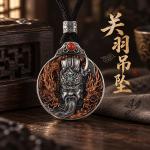
Guan Yu's face was settled by later generations. Chen Shou's Records of the Three Kingdoms says nothing about what he looked like. By the time of the Romance of the Three Kingdoms he had a face like a dark red date, lips as if painted, phoenix eyes, silkworm eyebrows, and a long beard that earned him the name Lord of the Beautiful Beard. Opera paints the face to that description and sculpture opens the face to it; several hundred years of plays fixed one face in place, and now it cannot be altered; whoever alters it is criticised. In religious sculpture his face must not be thin. Thin, and he looks like a civil official and cannot hold the space of a temple hall.
He carries three identities at once. In Buddhism he is Sangharama, the bodhisattva who protects monasteries. In Daoism he is Emperor Guan the Holy, who governs the fortunes of the living. In the shops he is the martial wealth god of the western route. Three identities stacked on one man, which is why he carries both a blade and the Spring and Autumn Annals. This piece takes the seated reading pose: the blade is not in his hand, and the weight settles on the book at his knees. The Sangharama identity is said to begin in the Sui dynasty, when the master Zhiyi was building a temple on Yuquan Mountain and Guan Yu appeared and asked to serve as its guardian, and from that time there has been a hall for him inside the temple gate.
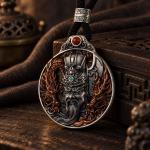
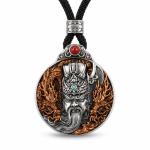
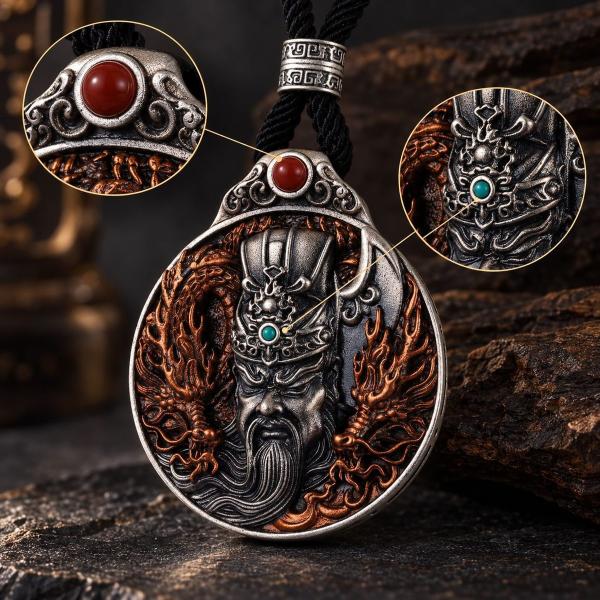
The reading pose is difficult to bring off. The hands have to gather on the knees, the cuffs hang down, one strand of beard falls to the chest, and the outline of the face has to be square with roundness in it. In a small piece the beard clumps most easily, so look at whether the strands are separated; a few strands are enough, and more than that becomes a tangle. The folds at the cuff cannot be cut deep either, because deep folds read as armour rather than ordinary dress. The beard on this piece is divided into five strands only. More than that on a piece this size becomes a single black mass.
The silver is darkened in the recesses, the brow ridge, the partings of the beard and the folds of the robe pressed dark while the front is left bright, so that the figure has an outline at a distance and layers at close range. Whether a Guan Yu image works comes down to the eyes: flatten the eyes and the whole face loses its spirit. The eyes here are two long, thin grooves with darkness left at the bottom of each, so a little light shows only when it comes in at an angle. Face on, they are lowered, and lowered is what looks like reading.
It is worn mostly by men, on a black cord, hanging to the heart. The pendant has weight, so the chain should not be too fine; a fine chain will be pulled long. Silver oxidises, but the raised parts of the face are rubbed constantly by clothing and tarnish less, while the places that cannot be reached, behind the ears and under the beard, go dark. Wrap it in a soft cloth when you put it away, and do not carry it in a pocket with keys, because a dent in the face cannot be repaired. In summer, with heavy sweat, a ring of salt collects on the cord; wash it off and it is gone.