


Menu
By theme
By theme







{{ variable.name }} : {{ variable.values[selectedVariantsIndex[variable_index]].name }}
Quantity:
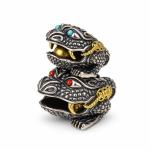
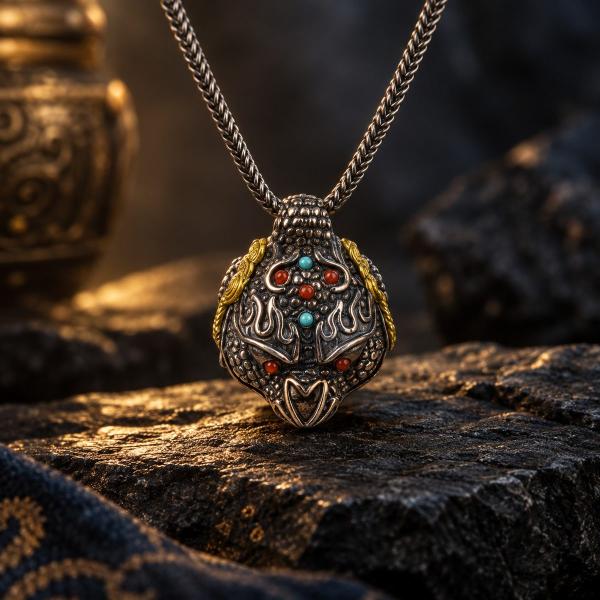
A three-legged toad is not something you find; it exists in legend. The tale of Liu Hai and the golden toad was widespread in the Ming and Qing, and it tells of Liu Hai subduing a three-legged toad that spat coins, so that wherever the toad went, money fell. The three legs are its mark. Four legs and it is an ordinary toad, which does not count, and no maker gets that detail wrong. A cord is also cut across the creature's back, the rope it was tied with, and only with that line does it count as subdued.
The Big Dipper is often engraved on the toad's back. It sits to either side of the spine and follows the run of the handle rather than running down the centre; laid out in a straight line it turns into a centipede. A string of coins hangs from the mouth, and the coins need square holes; how far the string drops depends on the size of the toad. These are the credentials by which the figure is recognised, and an old collector sees a mistake in any one of them at a glance. The mouth of the ladle faces up and the handle down, and if the direction is reversed, anyone who knows the convention does not look twice.
This piece carries a small bell. The body of the bell is round, and a hole has to be left when it is cast, placed at the base where it cannot be seen. A small hole and the note is dull; a large hole and the sound scatters. The hole here is on the small side. I have tried it: you hear it as you walk, it rings when you run, and it is not loud enough to be a nuisance. Silver bells are never sharp. A duller note is the deeper one, and it is nothing like a bronze bell. The clapper is made separately and sealed in afterwards, with the seam underneath, something you can feel but not see. The mouth of the bell faces down, so the sound travels downward, which is how it sounds best when hung.
The pendant comes in two sizes. The large one suits a cord and holds its own over heavy clothing; the small one goes on a fine chain and sits below the collarbone, where it does not ring, only shifts a little as you walk. Choose by height and by habit. If you already wear something at the neck, do not take the large one, because two pendants pressed together mean neither can be seen and the effect is clutter. Both sizes carry the bell, and the larger one has a thicker body and a lower note.
What a silver bell cannot survive is being crushed. Do not put it in a pocket with keys or coins: once the body is dented the note goes dead, and it does not come back. The loop it hangs from is open and loosens with wear, so pinch it closed now and then, with a cloth between the pliers so that no fingernail mark is left on the silver. In summer the inside of the bell collects a dark layer and the sound goes muffled; rinse it with warm water and let it dry. Oxidation begins in the seams of the bell, and black in the seam is not the same as damage.