


Menu
By theme
By theme









{{ variable.name }} : {{ variable.values[selectedVariantsIndex[variable_index]].name }}
Quantity:
Chitipati is a transliteration from Sanskrit, and it names the grove where sky burial is done. The Lords of the Charnel Ground are the masters of that grove, and in Tibetan Buddhist iconography they appear as a pair of skeletons, one male and one female, dancing with the knees bent, treading on a corpse, each holding a skull cup. What they express is impermanence, not menace, and looked at for long enough the image turns calm. They count among the protectors but never take the central seat; on a thangka they are usually painted into a corner, a pair of skeletons dancing in the charnel ground with burnt bone under their feet.
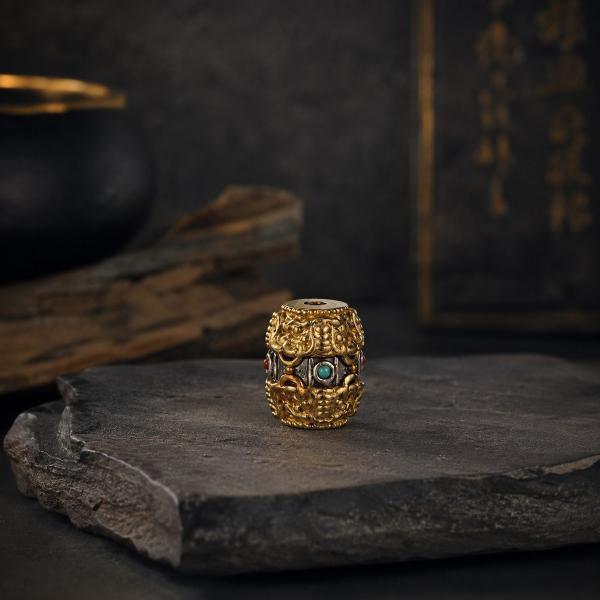
A three-hole bead is a junction in a strand. The beads come along one path and divide three ways here, which is why it is a size larger than its neighbours and why its holes have to run in three directions. The channels turn at right angles, and that is where threading is hardest: the cord bends most sharply at this point and is likeliest to break here first. Anyone who strings knows that a badly chosen three-hole bead throws off the balance of the whole strand, and that it never sits right on the wrist however you turn it. The two side holes have to line up; skew them and the cord runs diagonal, and once the three-hole bead is skewed the entire strand follows it.
This is a set of components in three forms: two single Chitipati pieces and one three-hole bead. Anyone who builds their own strands knows that components are harder to choose than finished pieces, because they have to match beads you already own. Size, colour and hole position all have to agree, and one mismatch means it will not go on. A hole that is too small has to be reamed, and reaming leaves the wall rough, which cuts the cord sooner. The two single pieces can be made into earrings or a back ornament; the three-hole bead can only serve as a node. The uses are distinct.
Skeleton detail is what gets lost at small size. The eye sockets have to be deep, the teeth separated one from another, the ribs countable. On this piece the teeth are distinct and the sockets are pressed deep, so that in raking light they are two black holes. The fingers are only the size of grains of rice, and knuckles cannot be made at that scale, only a bend, and a bend in the right place is enough. There are six ribs and no more, because more will not fit on a surface the size of a thumb.
Silver works with wooden beads, with coconut shell, with bodhi seed. With amber, put a spacer in between, or the hard edge of the silver will bite into the resin. String with a multi-ply cord rather than elastic, because elastic will not survive a year at a right-angle bend. An antiqued piece should not be polished often: polish takes the darkness out of the recesses, the skull goes flat, and once it is flat the character is gone. Antiqued silver suits old beads best. The older the beads, the less the silver ought to shine.