


Menu
By theme
By theme






{{ variable.name }} : {{ variable.values[selectedVariantsIndex[variable_index]].name }}
Quantity:
The head of a ruyi is a cloud. The object began as a back scratcher with the end of the handle shaped like a hand; later the hand gave way to a cloud head or a lingzhi head, the useful thing became an ornament, and the cloud head stayed. Cloud scrolls are older than the ruyi itself: vessels from the Warring States already carry cloud-vapour patterns that run around the body with no beginning and no end, and what they ask for is continuation without break. Cloud head up or cloud head down, both are seen in strands; turned up it looks light, turned down it looks steady.
An accent bead is punctuation. A strand where every bead is the same size grows dull to the eye, and adding one of a different shape every few beads gives the glance somewhere to land. That is the work a silver accent bead does. It is not there for beauty, it is there for phrasing. Two or three on a strand is enough; more than that and it becomes a silver strand with the wood playing a supporting part. Position follows convention as well, usually on either side of the guru bead, or one placed every nine beads. A spacer and an accent bead are not the same thing: the spacer is thin and sits between two beads, while an accent bead is meant to have form.
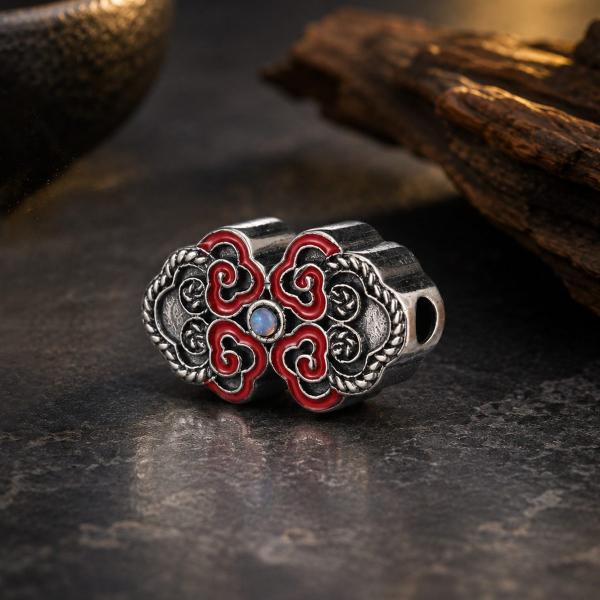
This one is plain: a cloud head on one face, flat on the other. The flat side rests against the wrist and does not dig in, and the hole is drilled true, so the bead does not sit askew once it is strung. The mouth of the hole is chamfered, which keeps the cord from fraying; it is a small detail, but it earns its place, especially on a strand worn every day and not taken off for showers. Silver accent beads usually take a hole half a size smaller than the wood, so that a thinner cord still leaves the strand tight.
How the cloud curls matters. A ruyi cloud has three curls, a large one in the middle with a smaller one on either side, and the centre of each curl has to be drawn tight; draw it loosely and the whole thing scatters into cotton wool. The curl centres here are solid, so light strikes a small highlight and the cloud comes alive. The grooves between the curls are left dark, and the layering rests on that darkness. Use a new polishing cloth for it. An old cloth carries grit, and grit turns the highlight into a layer of fog.
Silver and wood are a long way apart in hardness. Set beside bodhi seed or coconut shell, it is the wood that wears: after a few months the edge of the silver will have bitten a pale ring around the mouth of the hole. That is not a fault, it is what old beads look like. If you would rather it did not happen, put a softer spacer between them, and cowhide or coconut shell will do. When the silver darkens, the darkness caught in the seams is the best thing about it, so do not dig it out with a polishing cloth. Accent beads do not have to be paired. Two alike among three often looks better than three of a kind.