


Menu
By theme
By theme


{{ variable.name }} : {{ variable.values[selectedVariantsIndex[variable_index]].name }}
Quantity:
The master's sword is shaken, not swung. The blade is short, and the butt of the handle carries a large iron ring, with seven or eight smaller rings threaded onto that ring, so that shaking it produces a rattle. In folk Daoist rites, in nuo exorcist dance, in the sending off of deities, it beats time and opens the road. The sound matters more than the blade: let the beat go wrong and the whole scene comes apart. In nuo opera it is used alongside the ox horn and the divination blocks, as one set of equipment, and with a piece missing there is no performance.
Its form differs from place to place. Some blades carry a curve, like half a pair of scissors; some are made sword-shaped outright and keep only the ring. What they share is the ring. Without a ring it is not a master's sword, it is a dagger. The handle is usually wrapped in cloth or rattan so that it does not slip in the hand, since after long shaking the palm sweats and a bare handle will not hold. The number of rings varies by region, seven, eight, twelve; more rings give a finer sound and fewer a heavier one. The large ring has to be wider than the blade, or the small rings will not strike it audibly when shaken.
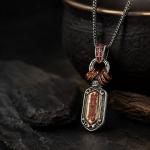
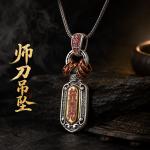
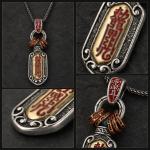
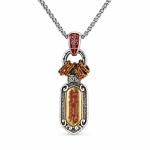
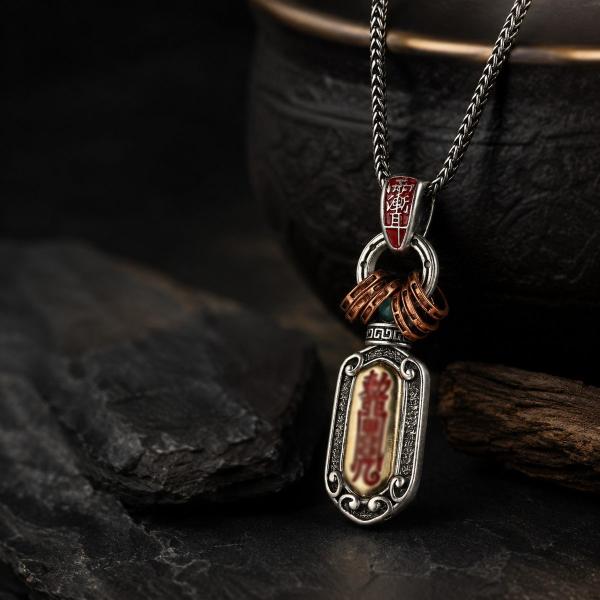
This pendant makes the ring solid. The smaller rings are brought out in shallow relief, one pressed over the next, so it does not rattle, but the form is still there. On a real one the rings have to move, link threaded through link, and shrunk to the size of a fingernail that cannot be made, or if it is made it breaks at the first touch. So the pendant keeps only the shape. Someone who knows the object sees at once what it is; someone who does not takes it for a small knife with a ring on the end. The ring on the pendant is thicker than on a real one, because thinner would not stand and the relief on the face would collapse. Only six small rings are cut on it, since more will not fit in a space the size of a fingernail.
The blade has no edge, and that is the discipline of jewellery. An edged blade counts as a controlled weapon and would cut whoever handled it. The edge is cut as a blunt ridge which catches the light as though it had been sharpened, but which feels round under the thumb; the tip is drawn in to a small round point, so it does not prick and does not dig in when worn at the neck. The line of the spine has to be straight. A little curve and it reads as a sickle, and the form is wrong.
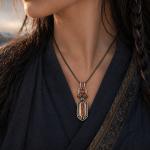
A Daoist object worn on the body is a matter of carrying, not of worship. There is no incense to burn and no auspicious day to choose; keep it somewhere dry. Tarnish on silver always starts in the recesses, and the spaces between the rings are the hardest to reach. Brush them dry with a soft brush, and do not pick at them with a needle, because a scratch does not come back. A scratch is uglier than tarnish: tarnish can be brought back, and a scratch cannot. When it is not being worn, hang it where air can reach it rather than shutting it in a drawer, since silver dislikes damp and dislikes being closed up.