


Menu
By theme
By theme



{{ variable.name }} : {{ variable.values[selectedVariantsIndex[variable_index]].name }}
Quantity:
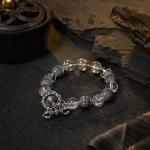
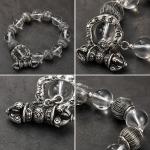
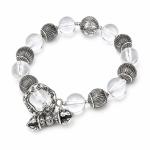
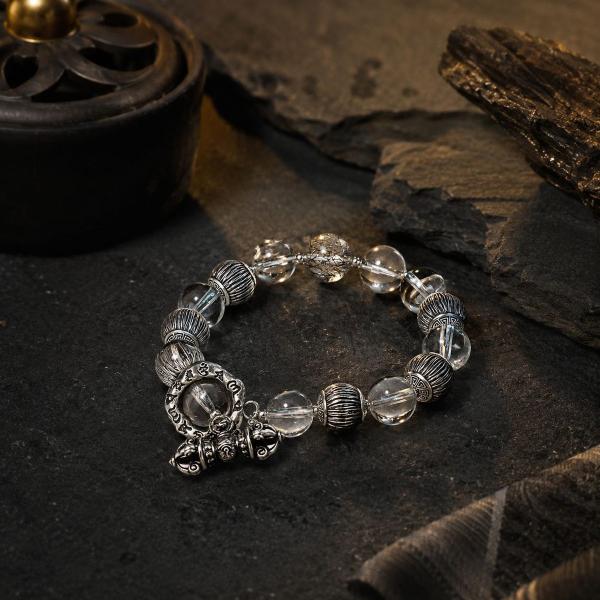
The number of prongs on a vajra carries meaning. One prong stands for the single reality, three for the three secrets, five for the five wisdoms, nine for the nine vehicles. What is seen most often is five: a central prong with four prongs on each of the four faces, all of them curving into a lotus form at either end. To read a vajra, count the prongs first. The wrong count makes the wrong form, and the wrong form carries the wrong meaning with it. The central prong has to be straight, the four faces have to be symmetrical, and seen end-on the whole is a cross set inside a circle.
The six-syllable mantra is engraved on the links of the chain, one syllable to a link, so that a single circuit of the wrist reads it through. Om mani padme hum is Avalokiteshvara's heart mantra, the most widely recited in Tibet. The six syllables are a transliteration and are not broken down for their literal sense. The script varies from place to place, Tibetan, Sanskrit or Lantsa, and this piece uses the common Tibetan form, whose strokes are round with few turns, which cuts without strain on a narrow face. The links have to be of one width throughout. One wide link and one narrow and the six syllables will not space out evenly.
Fitting a bracelet is harder than fitting a ring. A silver chain does not stretch: too long and it turns around the wrist, too short and it will not close. Two links are left removable, so you can try it at home and take one out for a fit that sits snug without swinging. Once it is on, you should be able to slide one finger underneath. If a finger will not go, it is too tight, and the pressure on the blood is uncomfortable. The clasp is an S-hook, which is stronger than a spring clasp and will not spring open by itself. Keep the link you take out. A lost one cannot be matched.
Where the vajra meets the chain is the point that takes the strain, and the solder there is thin enough that a pull will open it. Do not drag it on one-handed, and when you fasten it, hold the clasp rather than the body of the vajra. Silver is soft, and the tips of the prongs bend more easily than anything else on the piece. Bend one back slowly with a fingernail, not with pliers; plier jaws leave marks, and a mark on a prong is conspicuous. You can leave it on in the shower. Silver does not mind water; what it minds is shampoo left in the seams and not rinsed away.
The mantra is cut shallow, and it sits on the side of the links rather than the front. The front is kept for the vajra. I think that arrangement is right. The vajra is form and the mantra is sound; the form is on the face and the sound is at the side, so neither competes with the other. Silver darkens with wear and the seams of the links go black first, which sets off the six syllables and makes them read more clearly than they did when the bracelet was new. A bracelet soils faster than a necklace, because the wrist is always brushing across a desk, and the backs of the links darken first, so turn it over when you polish it.