


Menu
By theme
By theme


{{ variable.name }} : {{ variable.values[selectedVariantsIndex[variable_index]].name }}
Quantity:
A talisman has three sections: the head, the body and the foot. The head is usually drawn as three dots or three hooks, standing for the Three Pure Ones. The body is the core, either a ring of characters or a secret name. The foot closes the stroke, sometimes with a cross, sometimes with a coil. All three together make a talisman; with one missing it is only lines drawn at random, and worn on the body it has no order. The proportions run short at the top and long at the bottom, and the foot has to anchor the whole, a foot that does not anchor leaves the talisman floating.
Talismans are drawn on yellow paper with cinnabar, the old rule in folk practice. Cinnabar is mercury sulphide, a heavy colour that does not fade in light, and the yellow of the paper comes from turmeric or from sophora flowers, which takes the colour of earth. Together, anyone used to seeing them recognises them at once. Move them onto white paper with black ink and the force goes out of it; it looks like a note left on a table. Cinnabar is ground with water. Too thick and the brush will not pull; too thin and it bleeds. The paper should be old: new paper is too lively and the cinnabar will not take hold.
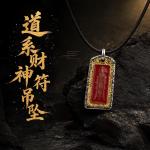
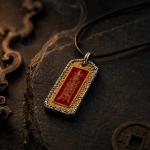
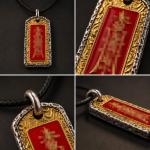
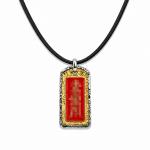
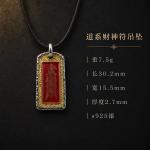
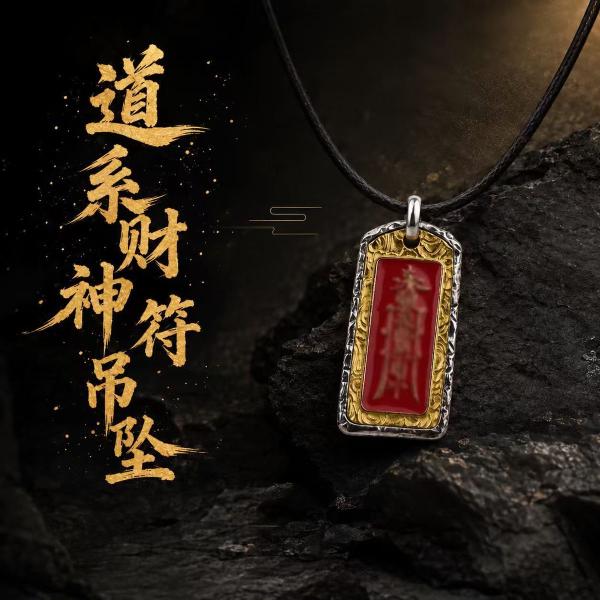
Cutting a talisman into a silver plaque is difficult because of the fineness. A cinnabar stroke has weight in it, heavy where the brush lands and light where it lifts, and silver relief cannot make a brush tip; it can only press the line to an even depth. Here the characters of the body are enlarged and the head and foot simplified, keeping the skeleton and giving up the flying white. Flying white belongs to paper. It cannot be cut in silver, and forcing it produces a ragged edge. The cuts are given round bottoms, which wear better than flat ones and do not hold dust. A plain border is left around the face of the plaque, because a talisman pressed against an edge goes stifled.
The back is plain, with a single hole drilled through it. People ask whether something should be cut on the back as well, and my answer is no: the talisman is a matter of the front, and carving the back would only dig into the skin. The face is a size larger than a one-yuan coin, so it does not look small at the chest and does not bulge when it is pushed inside a collar. The cord is red cotton, which is the folk habit rather than a rule about thickness. When the design is scaled down, settle the body first; once the body is fixed, the head and the foot give way to it.
An object like this offers peace of mind, not a promise. Wealth talismans are widely circulated in folk practice and their forms differ from one place to the next, so no single house's version should be taken as the only one. Some people care about the hour at which a talisman is drawn, some about the order of the strokes, and the more versions there are, the harder the choice becomes. With time a dull film settles over the silver and the cuts go black first, which is exactly what should happen: the lines of the talisman come forward. Do not go at it with toothpaste. And do not keep the plaque in the same pocket as a phone, since the glass of a screen is harder than the silver.