


Menu
By theme
By theme



{{ variable.name }} : {{ variable.values[selectedVariantsIndex[variable_index]].name }}
Quantity:
Tiger-head hats can still be found in villages in the north. When a child reaches its first month or its hundredth day, the mother's family sends one: the ears standing up, the eyes wide open, a wang character on the brow, and two small bells at the back. It asks for protection from harm, and for a child that grows up strong. Tiger-head shoes belong to the same line: the toe embroidered with a tiger's face, worn while the child learns to walk, so every step sets off a squeak. The lining of the hat is red cloth. That is the old rule, and it is followed even where the lining can never be seen.
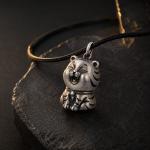
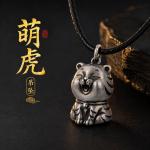
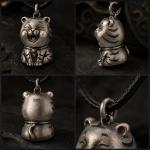
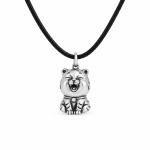
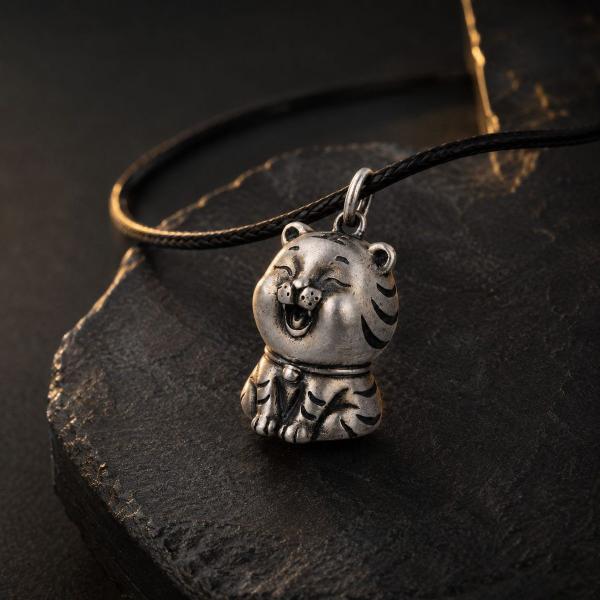
Cute is a word of the last few decades. In the old form the tiger was fierce: the teeth showing, the eyes glaring. This piece shortens the muzzle, enlarges the ears and reduces the eyes to two round dots, and the fierceness comes off. The difference between fierce and cute is not in the teeth but in proportion. A large head on a small body reads as cute, a small head on a large body reads as fierce, and it is the same rule as drawing cats and tigers. The nose has to be an inverted triangle; round it off and the animal looks like a bear. Pull the chin in a little, or the face looks square, and a square-faced tiger looks like a door god.
The forehead of this piece carries no wang character. Cut one and it becomes a New Year print; leave it off and the face is cleaner, and whoever knows the animal knows it is a tiger. The fur on the back is cut in short sunken lines pressed in one at a time and left unpolished, so the reverse side is matte. The cheeks on the front keep two round bosses, the pads of a tiger's face, and they feel slightly fleshy under the finger. One ear is set higher than the other, deliberately, since symmetry would only make it dull. The insides of the ears are left empty, with no fur cut into them, because empty is what lets them breathe.
It suits men and women both. The tiger has bulk to it, so a fine chain does not go with it; a leather cord or a heavier plain chain holds it properly. Worn outside a crew-neck sweater, with the head landing at the chest, it looks better than tucked into the neckline. With a shirt, tuck it in and let only the cord show, which is not conspicuous either. Take the leather cord at two millimetres: thinner will not carry the weight, and thicker looks like a collar. In summer, when clothing is thin, the head will look heavy, so shorten the cord and let it sit at the collarbone.
The ears are the thinnest, most fragile part. Do not set it down carelessly on a table, because the ear lands first and bends. If it does bend, do not go at it with pliers. Silver is ductile, so push it back slowly with the pad of a finger, two or three times, and it will come back most of the way; push it too far and it creases at the base of the ear, and a crease there cannot be smoothed out. Dust gathers behind the ears more than anywhere else, so cut a toothbrush short, dip it in clean water and brush there. Do not leave the pendant on a windowsill. Long exposure to sun turns the surface of the silver yellow.