


Menu
By theme
By theme

{{ variable.name }} : {{ variable.values[selectedVariantsIndex[variable_index]].name }}
Quantity:
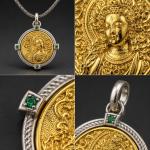
White Tara has seven eyes: three in her face, and one in each palm and one in each sole, seven in all. That mark is the key to recognising her. Make an image with one eye missing and it is not White Tara. The seven eyes mean that she sees the suffering of the six realms, one eye for each realm and the seventh for the whole of it. Their placing is fixed. The eye on the forehead is vertical, and the eyes in the palms face outward. The forehead eye is harder to cut than the horizontal ones, and made too small it simply disappears.
She is often confused with Green Tara. Green Tara is green in body and stands with the right foot stepping out; she saves from sudden danger and she arrives quickly. White Tara is white, sits in full lotus, and presides over long life and the clearing of obscuration; she arrives steadily. In Tibet, White Tara, Amitayus and Ushnishavijaya are known together as the three deities of long life, and a household with elders in it will often keep that set. In the arrangement White Tara takes the centre, Amitayus sits to the left and Ushnishavijaya to the right.
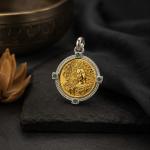
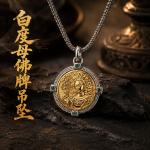
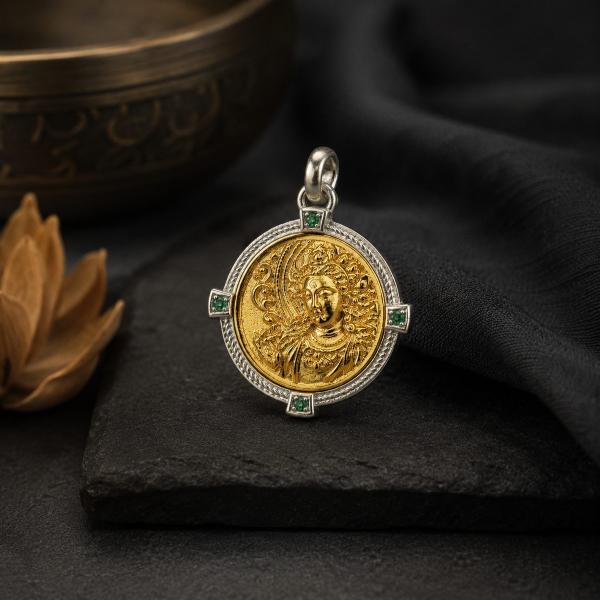
White Tara's right hand is in the gesture that grants wishes, palm turned out with the fingers hanging down. The left holds a white lotus, the stem passing between thumb and forefinger and winding up to the height of her ear. In a small piece that lotus is the first thing to be left out, and once it is gone she becomes a bodhisattva in general, and the seven eyes were cut for nothing. The lotus is kept here, with only three petals, which is enough to read. The eye in the palm is cut into the palm itself and only shows when the palm is turned outward. The fingers of the left hand have to stay together, with the tips resting on the stem; spread them and the hand goes slack.
The white of the silver and the white of Tara collide, and the result blurs very easily. What was done here was to polish the face and the hands bright and press the robe folds and lotus petals dark, letting light and shade separate flesh from cloth. At a distance it is a mass of white; close up it has layers. That balance seems to me the right one, and any brighter would be vulgar. The face is polished with fine abrasive, since coarse grit leaves scratches all running the same way. The robe folds are sunken lines, each pressed over the next; cut too shallow and they read as creases in the metal rather than as cloth.
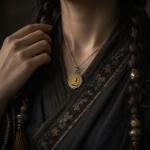
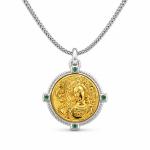
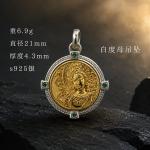
It is worn mostly by women, and sometimes bought by a daughter for her mother. Use a fine chain, long enough to sit below the collarbone. The pendant is not large and does not weigh on clothing. Silver darkens from the low points. The raised face is rubbed as it is worn and tarnishes less, and what goes dark is the seams of the lotus petals and the depth of the robe folds. Clean along the folds rather than wiping across them. The back of the pendant is flat, and the side that rests against the skin carries no cutting at all.