


Menu
By theme
By theme

{{ variable.name }} : {{ variable.values[selectedVariantsIndex[variable_index]].name }}
Quantity:
In Laojun's hands the fan becomes a tool of alchemy. In the business at Pingding Mountain, when Sun Wukong follows him to the Tushita Palace, Laojun recites his own inventory: the gourd holds elixir, the pure vase holds water, the sword subdues demons, the fan fans the fire, and the rope is the sash that ties his robe. Five treasures, with the fan fourth, and its use stated plainly enough. It is not there for cooling anyone down. The names of the five are itemised one by one in the book, and none of them is left out. Laojun's furnace stands in the Tushita Palace, and the fan is what governs that fire.
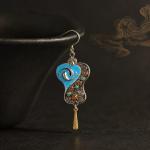
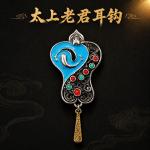
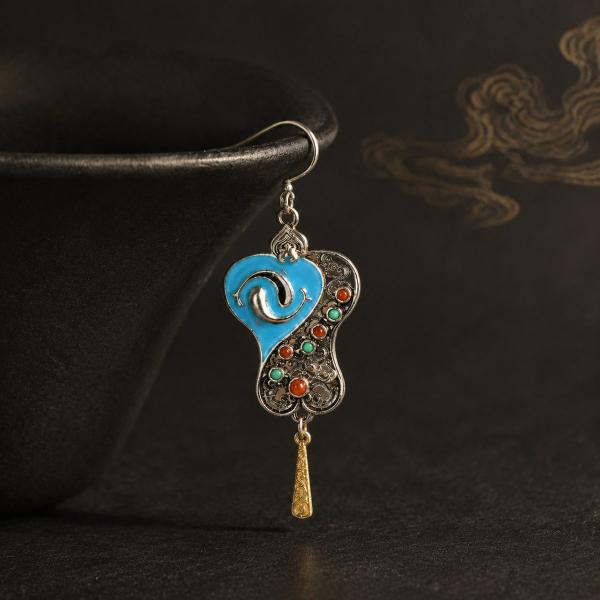
The banana fan's shape is a long handle, a broad face and clearly marked veins. Folk paintings of Laojun generally show him with the fan in his left hand and his right hand in his beard, the fan half open. Fully open it looks like a parasol, folded it looks like a stick, and only half open is it recognisable as itself. This piece makes the fan face a single leaf, with the veins radiating from the handle end and fine teeth along the edge where wind has torn the leaf. The handle usually carries a raised ring above the grip, which is the old form.
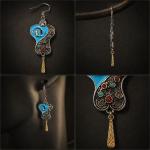
What makes a long ear hook difficult is balance. The hook hangs in the piercing, and a heavy drop below it turns the hook forward. The fan face here is made very thin, with a layer scooped out of the back, and the weight sits directly under the hook, so it does not flip as you walk. The scoop cannot go right through, or the front of the face collapses. The hook itself is given a slight curve that follows the shape behind the ear, so that it does not press after long wear.
The veins are sunk-cut, pressed in one at a time, with darkness left in the recesses. The edge of the fan face is rolled rather than cut straight, so that it cannot cut into the neck; the width of the roll has to be even, since one side wide and the other narrow reads as crooked from a distance. Thin silver sheet deforms more easily than anything else here, so take hold of the handle when you take the earrings off, not the fan face. The end of the handle carries a small loop, which can take a bead or be left empty.
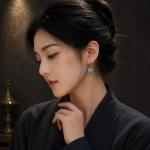
The subject is a cool one. Not many people like it, but the ones who recognise it are committed. Against dark clothing the white of the fan face stands well out; against pale clothing it blurs into the cloth. As the silver darkens the grooves of the veins go black first, which serves as the ribs; polish the raised surfaces only and leave the darkness in the grooves where it is. Images of Laojun are not common in folk practice, and most of them are paintings; jewellery is rare. The fan face is narrow and does not show much on the ear, and only at close range do you see what it is.