


Menu
By theme
By theme


{{ variable.name }} : {{ variable.values[selectedVariantsIndex[variable_index]].name }}
Quantity:
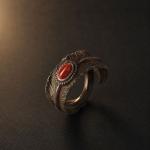
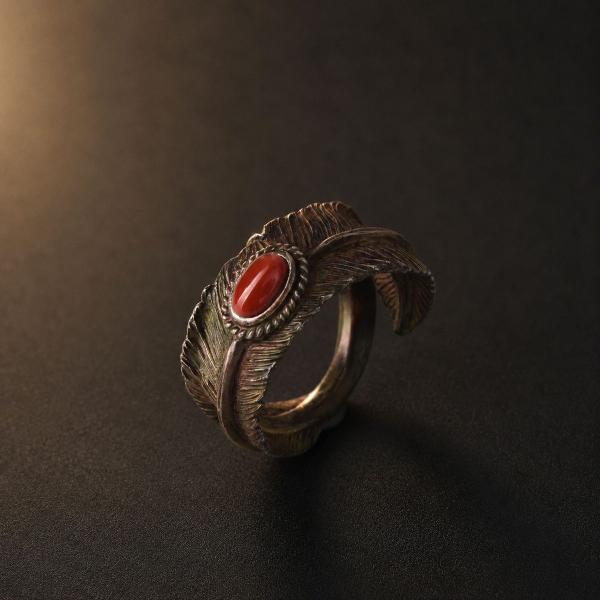
The difficulty of a feather is not the outline, it is the barbs. Along the shaft there are dozens of barbs on either side, of different lengths, longer close to the shaft and shorter toward the tip. Working in metal, each of those barbs has to be separated out. If it cannot be cast it has to be chased by hand, and one barb askew throws the whole feather into disorder. The shaft has to be stiff. Stiff, and it reads as a feather; soft, and it becomes a worm. The quill has to close to a point, and without a point the root smears into a lump.
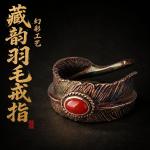
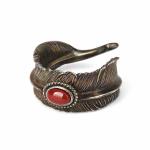
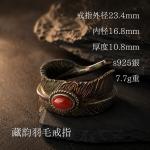
This ring keeps only twelve pairs of barbs, which is a matter of subtraction. Keep more and they smear into a single sheet at this size; keep fewer and it looks like a fish skeleton. Twelve pairs are enough to show the direction of the feather without being too dense to read. The ends of the barbs are given small rounded tips, so they do not prick and do not break easily. The angle of the barbs slants gradually from root to tip. Slant them all at the same angle and the feather turns into a comb.
South Red forms the quill and silver forms the vane. The boundary between red and white falls at the middle of the shaft, where a small channel is cut, the red set into it and the edge pressed down over it. This holds better than glue and will not fall out if the ring is dropped, but it fears a knock: a blow on the setting chips the stone, and a chip cannot be filled, only the seat rounded off, which leaves the quill a little shorter. The piece of South Red cannot be too thin, or light passes through it and the red goes pink. The rim of the seat is pressed thin so that it does not block the red, and thin rims curl easily. The edge of the quill is rounded so that it does not scrape the skin.
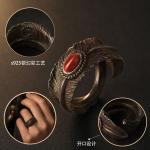
The band opens and adjusts, and the vane curves along the line of the finger. Wear it with the tip toward the fingertip, which is the natural direction; turned toward the back of the hand it pushes, and the ring is uncomfortable when you make a fist. The gap is left at the lower end of the shaft, hidden on the little-finger side, where it cannot be seen from the front. The inside of the band is curved to fit the base of the finger, and the two ends at the gap do not scrape.
A feather is a light image in jewellery, and it sits opposite the weight of South Red: one light, one heavy, so that the hand does not feel dull. Tarnish on the silver begins in the grooves between the barbs, and it is the lines that darken first rather than dirt. One pass with a polishing cloth pressed onto the vane is enough; do not rub back and forth, because too much rubbing flattens the barbs. Take the ring off when you wash your hands, since soap left in the setting dries white. The shortest barb at the tip is the one most often missed, and a missing barb leaves a bald patch in the feather. The vane is thin, so support it from below when you handle it.