


Menu
By theme
By theme




{{ variable.name }} : {{ variable.values[selectedVariantsIndex[variable_index]].name }}
Quantity:
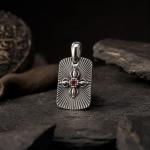
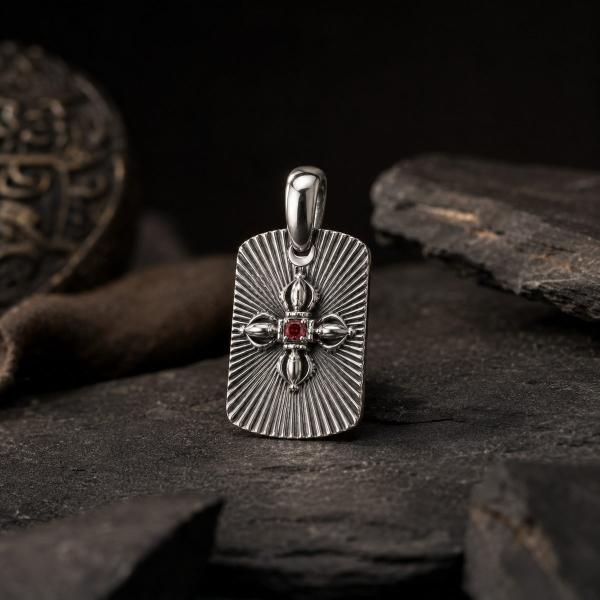
The crossed vajra is called karma-vajra in Sanskrit. Two vajras are crossed, with a prong in each of the four directions, and together they stand for all activity. A single vajra stands for wisdom; crossed, it stands for action that reaches all four quarters and leaves no blind spot. At large monastic ceremonies these are set at the four corners of the platform, so that the boundary holds and nothing leaks through. The four faces stand for the four activities: pacifying, increasing, magnetising and subjugating. The crossing point is at the exact centre; a little off and the four prongs are no longer equal. The pattern on the prongs is a string of beads, one after another, pressed along the ridge.
The form of the dog tag comes from the military identity disc. Two to a set, one worn at the neck and one on the bootlace, for identifying the dead. The form entered jewellery and became the dog tag: rectangular, with rounded corners and two holes at the top. Its advantage is the area, which will hold a complex pattern. Its disadvantage is that it looks like military issue, and does not go with formal dress. The two holes sit at the top corners and have to be symmetrical, or the tag hangs crooked.
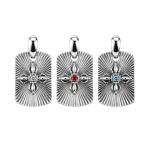
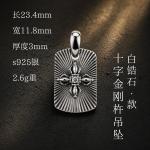
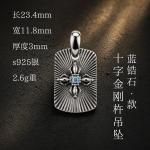
On this piece the vajra is cut in relief and pressed onto the face, the prongs reaching from the centre toward the four corners with the tips standing slightly proud of the edge, as though about to break out of it. Blue, red and white are the three colourways: the blue on the dark side, the red muted, and the white the natural colour of the silver. Each works with clothing differently, blue with black and grey, red with khaki, white with anything. The relief is kept low: high and it catches on things, low and it cannot be read. All three colourways keep a line of silver at the border, and the colour does not reach the edge.
The plate is thick and has weight in the hand. Hung at the chest it knocks against bone when you run, so take it off for sport. Use a bead chain rather than a fine one, since the weight of the plate will pull a fine chain long. Passing the chain through both holes at the top is what keeps the tag from turning over, and that is an old solution. A line of small characters is cut on the back, invisible unless you look closely, which is the old convention for a dog tag.
The tips of the prongs are the most exposed place on the piece: they stand proud of the face and bend at the first knock. If one bends, do not reach for pliers; hold it with a fingernail and push it slowly. Whether the silver darkens evenly shows on the flat parts of the face, since the recesses go darker and the two tones do not match. To even it out, do not polish only one spot. Of the three colourways, white is the hardest to keep, because any trace of tarnish shows on it. The four corners of the plate are rounded, so that a knock does not spoil the look of it.