


Menu
By theme
By theme




{{ variable.name }} : {{ variable.values[selectedVariantsIndex[variable_index]].name }}
Quantity:
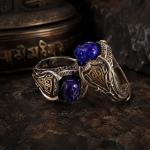
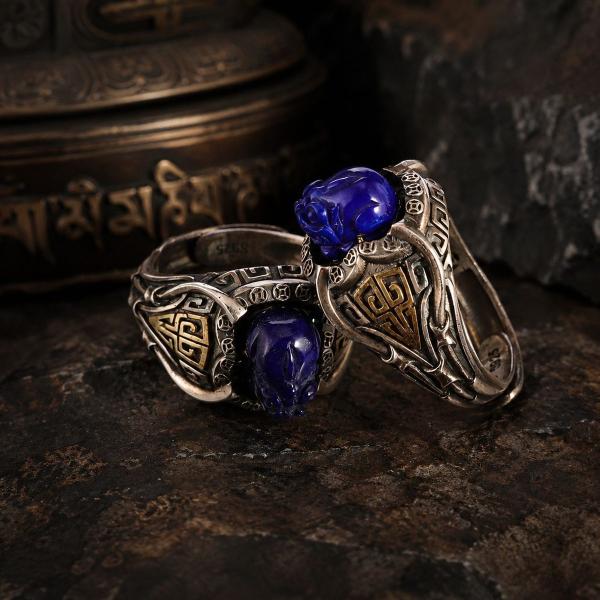
The blue of lapis carries flecks of gold. Those gold flecks are pyrite and the white ones are calcite; good material is purely blue, the gold fine and not crowded, the white sparse. Old books describe its colour as being like the sky, and the blues of the Dunhuang murals were painted with powder ground from this stone. The finer the powder is ground, the deeper the blue, and on a wall it does not fade in a thousand years. Gold that is too dense turns the blue grey, and gold that is too sparse looks like scattered sand; even and uncrowded is best. Too many white flecks of calcite and the blue goes patchy, so hold the stone to the light when you are choosing.
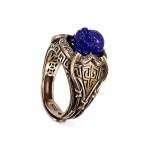
A pixiu has either one horn or two. The one-horned creature is tianlu and the two-horned one is bixie, and folk usage calls both of them pixiu, saying of either that it takes in and never lets out. This one has a single horn, the head facing forward, the mouth slightly open, the forelegs low to the ground and the haunches raised: a pose that is gathering force rather than lying down. The mouth has to be open. Open, and it can hold what it takes; closed, and it is a lion. The foreclaws have to be cut as three toes, since if they cannot be told apart they become hooves. The tail curls behind the haunches, and it curls tight; loosened, the whole figure falls apart.
The fret pattern runs a full circuit beneath the pixiu's feet. It comes from the thunder pattern on Shang and Zhou bronzes: a square set inside a square, joined end to end with no break anywhere. When it is cut it has to run continuously. Break it in one place and the qi is broken, which is what the old craftsmen said, and it is also a matter of the eye, because a break simply looks disordered. The fret here runs unbroken, and the corners are square with a trace of round, or the ring would cut the hand. The squares have to be of one size; one large and one small, and the pattern looks messy.
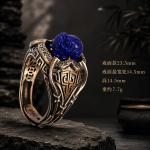
The band opens and adjusts, and the face is wide, taking up half the finger. On a short finger a wide face makes the hand look shorter, and that should be said before anything else; on a long finger a narrow face looks mean. The lapis is set into the centre of the face with a rim of silver pressed over it all round, and the rim has to be even, since one side wide and the other narrow leaves the stone sitting crooked. The rim covers a third of the stone. Less and the stone can fall out; more and it hides the colour.
Lapis dislikes acid. On someone who sweats freely, the edge of the setting will go white after long wear. The stone is not damaged; what has happened is that salt from sweat has seeped in and dried there, and a soft cloth with clean water pressed against it will lift the salt away. Do not soak it. Over time the grooves of the fret go black first, and the black lines draw the pattern out better than it looked when new. Do not clean lapis in an ultrasonic bath, because vibration opens cracks along the cleavage. And do not leave it beside a radiator, since long heat will crack it.