


Menu
By theme
By theme



{{ variable.name }} : {{ variable.values[selectedVariantsIndex[variable_index]].name }}
Quantity:
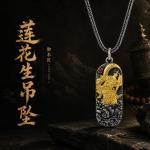
Padmasambhava is the figure who came into Tibet from India in the eighth century, and the Nyingma school honours him as its founder. In Tibet he is usually called Guru Rinpoche, the precious teacher. His image is easy to pick out in the Tibetan system: one hat is enough. Tradition says that on the road into Tibet he subdued a number of local deities, stories told widely there and often painted as a whole series on temple walls. His biographies exist in many versions, several of them recovered as terma, and the details rarely agree. Tibet regards him as a second Buddha, a title the other schools accept as well.
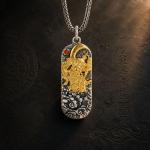
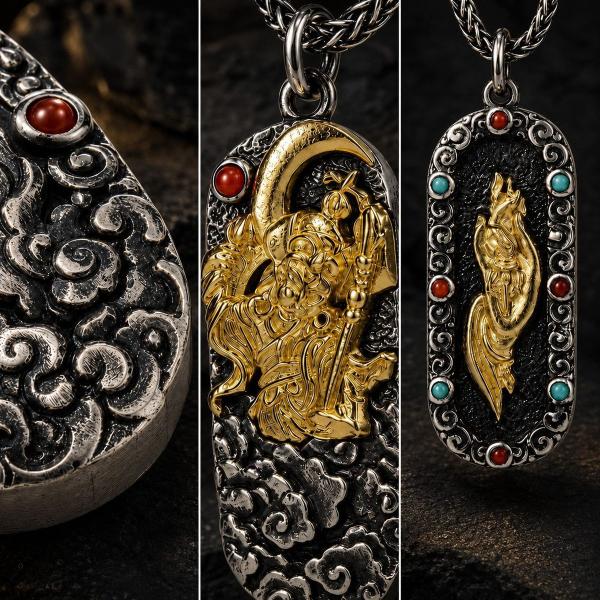
The hat is the lotus hat: pointed, with the brim turned up and a small half-vajra standing at the crown. The right hand holds a five-pronged vajra at the chest, the left supports a skull cup, and the left arm cradles a khatvanga staff whose head carries three levels, for the three bodies. He usually sits in the posture of a king, right leg extended, relaxed rather than formal. The dress is that of a tantric master, not a monk, which is why he has hair and earrings. The three levels of the staff are sometimes read as the three divisions instead; there is more than one explanation.
Tibetan chasing works differently from Chinese. The robe folds are not pushed smooth with a round graver; the lines are sunk one after another, and the line is hard, the turns hard with it. The face is left flat by contrast, with only the edges of eyes, nose and lips lifted a little, so you see them when light comes in at an angle. The back is usually plain, occasionally with a few cloud lines chased in, and the border left wide. The bottom of a sunk line is not polished, so light entering scatters there and the cut looks deeper than it is.
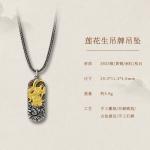
This pendant suits a Tibetan-style braided cord, and red, brown and dark blue all sit well. A chain works too, but a thin silver chain cannot hold it down, so choose a heavier link. The piece has weight, so do not wear it running; it swings and strikes the chest. Worn against the body, keep it outside your undershirt so sweat does not soak it directly. Tie the knot behind the pendant, trim the cord ends short and singe them so they do not fray.
Left for a long time, a silver piece darkens all over, and the sunk lines go black first. Wipe only the raised surfaces with a silver cloth and do not push the cloth into the lines, where the nap catches. If it really needs cleaning, work a soft brush with soapy water along the lines, rinse with clean water, press dry with a cloth and leave no water marks. Near the sea, remember that salt mist is harder on silver than sweat. Do not seal silver in a plastic bag, since trapped air darkens it faster; one layer of tissue paper is enough.