


Menu
By theme
By theme



{{ variable.name }} : {{ variable.values[selectedVariantsIndex[variable_index]].name }}
Quantity:
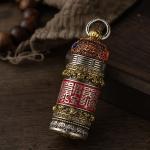
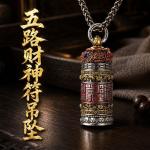
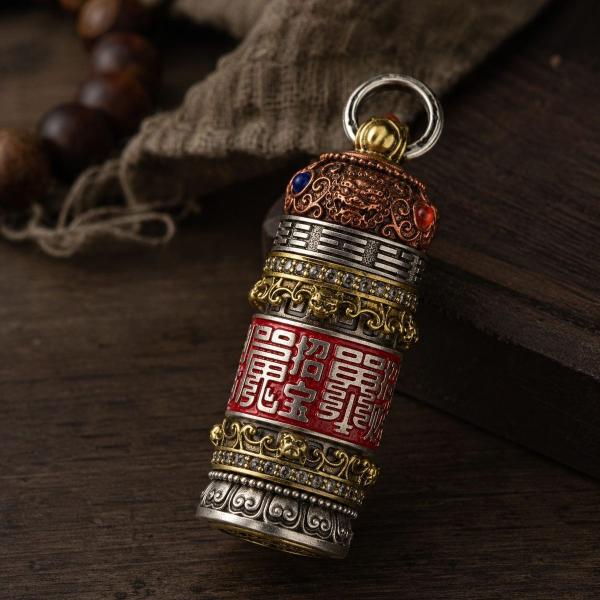
A talisman and an image are not the same line of work. An image needs a face, clothing and posture; a talisman rests on writing and secret characters alone, and the forms of the characters are the entire content. A five-direction wealth talisman sets the names of the five in one place without drawing anyone, and someone who reads them knows from the head of the characters which direction is which. A talisman's layout wants fullness: too much empty space looks thin, and the characters should push to the edge without touching it. The plaque is small, so the characters must be crowded in, and fitting them is where the skill shows. Keep the border narrow and the characters look larger. Silver does not mind damp, and it will not go brittle with age the way paper does.
The arrangement of the five differs from place to place. One uses the four of Recruiting Treasure, Gathering Rarities, Drawing Wealth and Profiting the Market together with Zhao Gongming; another assigns Bi Gan, Guan Yu, Chai Rong, Wang Hai and Zhao Gongming to east, south, west, north and centre. This piece follows the second, with the five side by side and no ranking. Both circulate among the people, neither is wrong, and it comes down to lineage. A talisman with five abreast is read left to right, or sometimes top to bottom, depending on the setting. Zhao Gongming holds the steadiest place among the five; both lists include him, only in different directions.
Read a talisman by the head first, then the belly, and the closing stroke at the foot. The characters you cannot read are mostly secret names, and there is no need to force them; a wrong reading is worse manners than none. The joins between characters were cut in one continuous passage, and once broken they scatter. Joined strokes are harder on silver than on paper: hurry the graver and it skips, and a skip is a break. Not recognising a secret name is normal, and those who can read one do not recite it aloud. The graver has to stand upright on a talisman; lean it and the line goes weightless.
Plaques like this are carried against the body, inside clothing, not shown. Some people sew them into a small cloth bag, others hang them straight on a cord. Take it off to wash or swim, since sweat and chlorine both dull silver. Passing it through a collar, do not hook the cord over a zip, which will bite into it. Use a cotton bag rather than a synthetic one, which does not breathe and traps sweat inside.
The cuts on a silver plaque are shallow, and dust fills them into a smear. Brush dry with a soft brush along the direction of the strokes, not in circles. Press the silver cloth on the raised surfaces only and leave the dark in the grooves, where the characters keep their bones. The plaque is thin, so do not pinch it hard; over time it bends. When the cuts have worn smooth, the piece has been worn for years, which is no bad thing.