


Menu
By theme
By theme

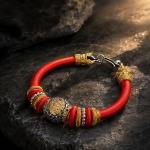


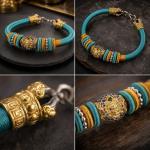
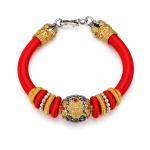
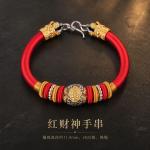


{{ variable.name }} : {{ variable.values[selectedVariantsIndex[variable_index]].name }}
Quantity:
The five Jambhalas of Tibetan Buddhism are divided by the five directions and five colours: yellow, white, red, green and black. Each has a different body colour and different implements in hand, so on a thangka they separate at a glance, while one alone is easy to confuse. The scheme relates to the system of the five-direction Buddhas, and the colours are not assigned at random: yellow sits at the centre, the other four take the directions. On a thangka the five are often set in a row, and with the colours laid out a reader does not need the faces. Their hand gestures differ too, some giving, some holding jewels.
Yellow Jambhala is golden in body, holds a wish-fulfilling jewel and cradles a mongoose; White Jambhala is white, usually with three faces and six arms, holding a jewel staff and a mongoose; Red Jambhala is red, often in union form with a consort in his arms; Green Jambhala is green, holding a treasure vase in one hand; Black Jambhala is dark and the plainest in form, without armour. Their postures differ as well, some with legs extended, some cross-legged. Yellow Jambhala's mongoose should be biting a jewel, and the right version has its mouth open.
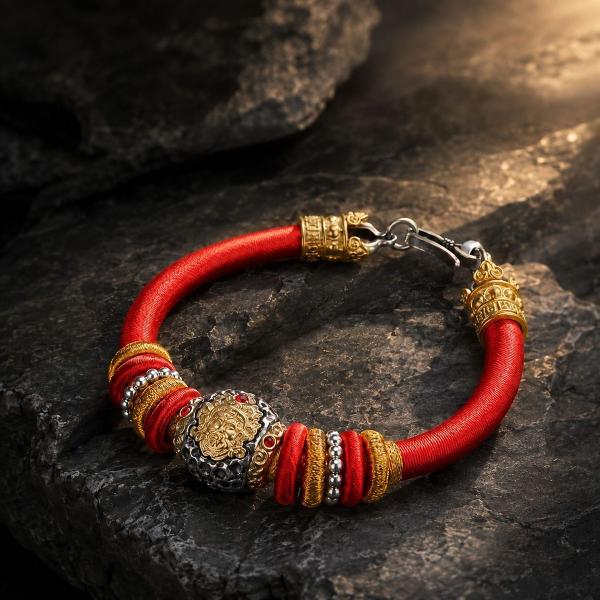
The beads and the silver piece have to balance. Silver drags downward: beads too light and the strand turns over, beads too heavy and the silver looks small. Put the silver on both sides of the Buddha head when stringing and the balance holds. If the beads go up a size, the silver must go up a size with them; get the proportion wrong and it looks cheap. Bracelet cord comes in elastic and non-elastic kinds: elastic is easy to put on, non-elastic looks better. Try the strand on before tying off, and judge the fit by whether it turns once around the wrist.
Choose colour by complexion. Yellow and red warm the face, white and green look fresh, black is steadiest and hardest to dress. One strand in each of the five colours is too much; pick the one that suits your ordinary clothes. As a gift, Yellow Jambhala is the easiest to receive and Black Jambhala runs cool, liked by people who know. Black Jambhala against dark beads blurs into one mass, so add a white spacer between and the two separate.
Silver wears fastest where it touches the beads, and in time the beads take a white ring. That is normal. Cord is a consumable: change elastic every six months to a year rather than waiting for a break. When you restring, wipe the silver at the same time and blow the cord fibres out of the hole. Where a silver piece has darkened and the cloth cannot reach, use a cotton bud with a little soapy water.