


Menu
By theme
By theme






{{ variable.name }} : {{ variable.values[selectedVariantsIndex[variable_index]].name }}
Quantity:
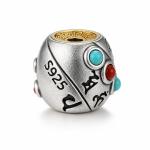
The eight-facet shape turns up all over Tang and Song metalwork. Silver and gold vessels were divided into lobes, glass was ribbed, and light falling on a ridge broke there instead of gathering into one pool of brightness the way it does on a round form. Scaled down to a bead, the eight faces give the characters somewhere to sit. Craftsmen who cut ribbed beads like the shape for that reason: more faces mean polishing has a rhythm, one facet after another, and no way to hurry it. A thin ridge is left standing between the faces as a boundary, so the characters do not touch each other and the bead does not look crowded.
This bead spreads the six-syllable mantra across the eight faces. Six characters, om ma ni pad me hum, plus a spacer motif on the two remaining faces, and the ring closes exactly. The cutting is incised and shallow: run a fingertip over it and there is a faint rise and fall, nothing that catches the skin. The silver is on the white side, so the sunken characters read dark. They come clear only when the light rakes across them and almost disappear head-on. That restraint suits it as the main bead of a strand, or as a single bead knotted at the end of a cord with nothing else on it.
The difficulty in a ribbed bead is the ridges. Eight lines have to run equally straight and meet at equal angles, and the polishing must not let an edge collapse. Let one go a little and the bead is neither round nor square, and there is no repairing that except back into the crucible. The S925 alloy is what lets the silver hold an edge; fine silver is too soft, and a ridge on something worn daily rounds off inside two months. Silver oxidises, and the recesses darken first, so the characters end up clearer than they were when new. A silver cloth worked in one direction brings the white back.
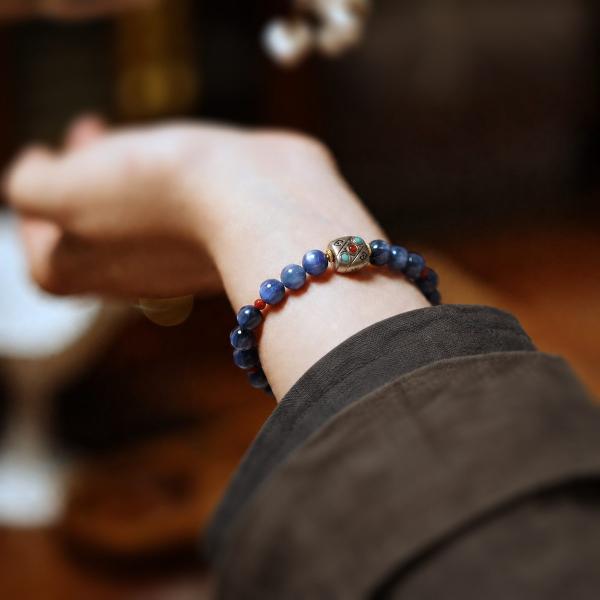
There is an order to stringing it. The hole is straight, so a thick cord turns a corner at the mouth, and that is where it wears through fastest. A thinner plain cord, or a small spacer bead at each end, keeps the line running true. It works as a main bead with round beads or barrels on either side. What it does not want is a large pendant hung below it, because the octagon already carries weight and will tip. A single bead makes a necklace on its own, hole upward and one facet facing out, and then the characters can be read. Cord slackens with use, and restringing costs less than a new cord. The mouth of the hole is polished, so a new cord slides; give the finish an extra turn.
Do not push it to the back of a drawer. Silver dislikes damp, and it dislikes being heaped in with copper or iron; one knock leaves a white mark on a ridge that no amount of polishing will take out. Keep it in its own bag with an anti-tarnish strip, which is less trouble than any clever remedy. The ridges are both the best thing about the bead and the most easily damaged part of it. Ten seconds of care when you put it away saves a good deal of trouble later.