


Menu
By theme
By theme






{{ variable.name }} : {{ variable.values[selectedVariantsIndex[variable_index]].name }}
Quantity:
Whether a strand looks well is decided mostly by something other than the main beads. Main beads are chosen for material and colour; spacers govern rhythm. Two spacers divide a run of plain beads into three sections, the eye has somewhere to rest, and the strand stops feeling inert. This lotus spacer is made for exactly that job. There are many materials for spacers: wood is light, stone is heavy, and silver falls between the two, neither pushing itself forward nor standing aside.
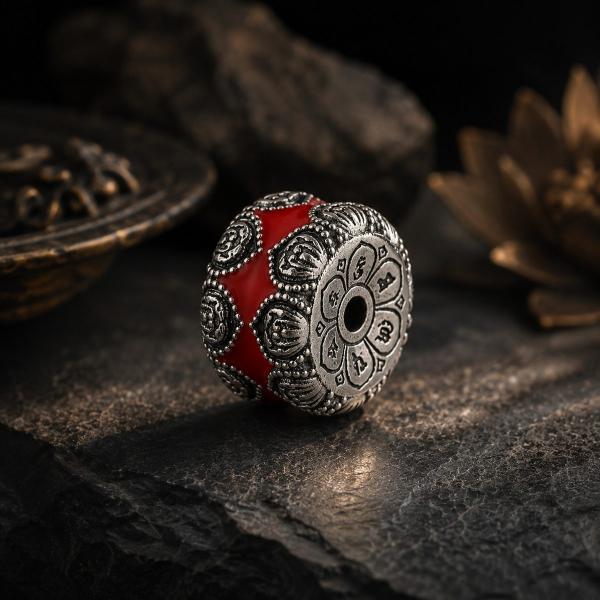
The lotus is cut in two layers of petals, the outer ones open and the inner ones held in, the tips given a slight curve so that there is visible depth head-on. The band at the centre carries the six-syllable mantra, cut small enough that you have to bring it close to read. Cutting at that size, a graver that runs fast will chip the edge, so it goes slowly and the labour shows up in the price. Silver's hardness happens to suit it: too hard and the graver will not bite, too soft and it will not hold the point. The grooves are left dark and the raised parts brightened, which is what stops the flower reading as a plain disc.
A silver spacer shows to best advantage in a dark strand. Against South Red, coconut shell or old sandalwood, one point of white lifts the whole run; where the main beads are already pale, the silver sinks back and serves only as a division. When choosing, set the spacer beside the main bead rather than judging it on its own. Everything looks well alone; it is together that you find out whether the two agree.
The hole runs straight through, with the mouths slightly tapered so the cord is not scraped. A spacer one size down from the main bead looks right; at the same size there is no hierarchy to read. Odd numbers lay out well, three beads to a section or five to a section, one holding the middle and the ends matched. If you are unsure, lay the strand out on a tray first; arranging on a table is less work than stringing and taking apart again. If a hole mouth is burred, roll a narrow strip of fine abrasive paper through it a couple of turns. Do not use a file, which cuts the mouth at a slant.
The six-syllable mantra is the most frequently carved subject in Tibet. Om mani padme hum, the heart mantra of Avalokiteshvara, cut into a bead to mean that it is carried with you, not because the bead thereby acquires a power of its own. Silver oxidises, and once the characters darken they read more clearly than when new, which is one small advantage of wearing silver a long time. When storing, do not put it in the same bag as agate or garnet. The hardness gap is wide and a few rubs leave fine scratches on the silver, and once the surface has scattered, the shine does not come back.