


Menu
By theme
By theme




{{ variable.name }} : {{ variable.values[selectedVariantsIndex[variable_index]].name }}
Quantity:
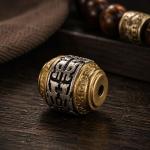
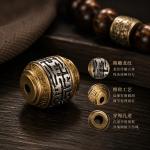
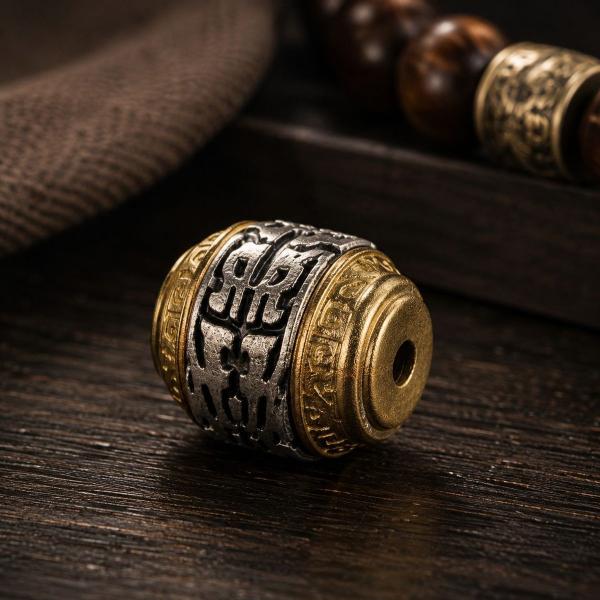
The barrel bead is the bone of a strand. Round beads are soft, barrels are hard, and one barrel sets a skeleton under everything else. Old strands show barrel shapes often: flat at both ends, swelling through the middle, sitting against the wrist without rolling, and comfortable under the fingers when the strand is turned.
The dragon here is carved in relief. The body coils, the head sits to one side, the scales are laid one over another, the raised passages are polished bright and the ground left dark. Light and shadow together and the pattern appears. Relief costs more labour than line engraving: the height has to be even, and going too deep looks clumsy while too shallow goes flat, so it all rests on a small reserve of judgement in the hand. After carving comes a burnishing pass, taking the highest scale ridges up to a shine, and that is what gives the dragon its alertness. The whiskers and mane are cut as a few strands drifting to one side, so that a still object has wind in it.
Dragon patterns have been on objects for thousands of years, from bronze to porcelain to woven cloth, and each dynasty drew them differently. Han dragons are long and slender, close to snakes; Ming and Qing dragons have large heads, spread claws and an outward force. This one takes the later route: a thick body, a mane swept back, no detail cut into the eye, since at a distance the momentum is enough. Song and Yuan dragons bend more, as though turning over inside cloud, which is a different taste altogether. The cool white of the silver holds that force back a little, so it does not tip into vulgarity.
In a strand the barrel usually goes in the middle, or two of them sit symmetrically at the sides. The hole is straight and takes a thick cord without trouble. Do not tie the knot beside the barrel; a knot pressing on the swelling face will dig into the wrist. With plain round beads it is the safest choice, and with carved beads it quickly gets busy, two places competing for the same eye. A single barrel on a long cord makes a good collarbone necklace as well, standing upright and carrying more presence than a round bead. A slim wrist needs one; a fuller wrist can take two with a round bead between, and the proportion holds.
The convex surface is what silver loses first. Worn daily, the raised scales brighten before anything else, which is normal; silver comes alive with wear. What actually needs guarding against is a knock. A raised point struck against the corner of a table will flatten a small area, and that does not come back. Do not lay it face down when you take it off, and do not sleep in it, because lying on the swelling face will distort it. If a shallow dent does appear, silver is ductile and can be pushed back a little from behind, though the pushed place will keep a mark, so do not keep working at it.