


Menu
By theme
By theme




{{ variable.name }} : {{ variable.values[selectedVariantsIndex[variable_index]].name }}
Quantity:
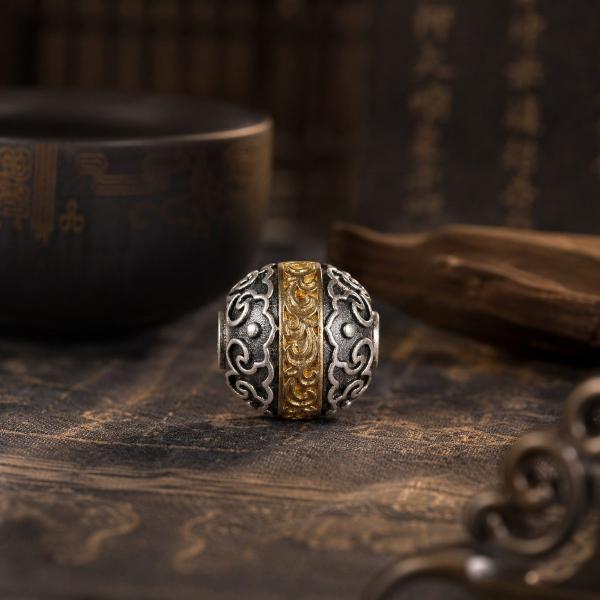
The scrolling vine is not a flower but a way of running a line: one main stem, tendrils thrown off to either side, ring following ring without a break. Its ancestor came in with Buddhist art during the Wei and Jin, the honeysuckle pattern, with slender leaves curled tight. By the Tang the stem had been drawn out longer and the curls made rounder and looser, and that is the continuous form that later fills borders on brocade, bronze mirrors and the friezes of cave temples. In Japan the same line is called karakusa. Different name, same handwriting.
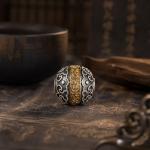
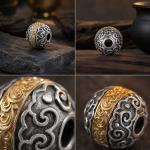
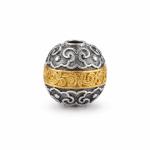
This is a ball bead, and the pattern has to travel round a sphere. Laying out a design on a sphere is the hardest part of the job: a vine drawn on the flat comes up half a turn short when it is wrapped, and the join has to be hidden on the side nobody looks at. The matching here is fairly even, so whichever way you turn the bead the vine does not suddenly stop. The diameter is small and the vine runs only three circuits; a fourth would crowd into a knot and the line would stop reading.
The ruyi began as an object, not a pattern. One account has it arriving from India as a back-scratcher; later it was held during sermons as a tally for keeping one's place, and only after that did it become something to leave on a desk. Putting a ruyi head onto scrolling vine borrows the luck in the two words, as you wish, and it is not the same thing as the ruyi carried in the hand of a Buddhist figure; the two should not be told as one story. Desk ruyi usually have a lingzhi head or a cloud head, and either will join onto scrolling vine without a seam.
A ball spacer is more useful in a strand than a flat one. A flat spacer has a direction, and a quarter turn leaves it crooked; a ball is right whichever way it ends up. With plain-coloured main beads such as moon-and-star or bodhi, one ball sets the tone for the whole strand; with coloured stones such as South Red or amber, the white of the silver becomes a dividing line. You do not need many: one in the middle, or two at the sides, and any more starts to fidget. The mouths of the hole are chamfered so the cord turns inside without being cut.
The recesses of the pattern collect sweat and darken with wear. That is oxidation rather than dirt. A silver cloth pressed onto the sphere and turned a couple of times brings the raised vine up bright while the recesses stay dark, and the pattern reads more clearly than before. Do not soak it in silver dip: it comes out uniformly white with the pattern flattened along with it, and that layering is the most valuable thing about silverwork. A ball bead is also the least forgiving if dropped; on a tiled floor the raised vine chips first, and a chip leaves a white gap that cannot be filled.