


Menu
By theme
By theme



{{ variable.name }} : {{ variable.values[selectedVariantsIndex[variable_index]].name }}
Quantity:
A talisman is easier to describe in form than in content. The sheet divides roughly into three: a head, a body and a foot. The head carries the Three Purities, the body carries the text, the foot closes the stroke. Made as a pendant, the three parts keep their proportions, and the ink line on paper becomes a shallow cut in silver. Carving is not painting: a painted stroke never lifts, while a carved one goes a segment at a time, and the joins show at the corners of the groove. The Three Purities at the head are often reduced to three circles or three horizontal strokes.
The Five Routes of Wealth come out of the folk arrangement of wealth deities: the eastern route calls in treasure, the western gathers precious things, the southern invites wealth, the northern brings profit, and the centre belongs to Zhao Gongming. What the five routes mean is that income may come from whichever direction you travel in, which has little to do with any particular image, and that is why a talisman face like this often carries writing and no figure. Zhao Gongming has his own iconography — black face, heavy beard, riding a tiger with a whip in hand — and that belongs to temple practice. Of the five, the centre leads and the other four hold the directions; on a tablet the centre is placed in the middle for the same reason.
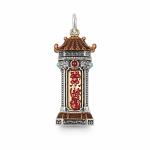
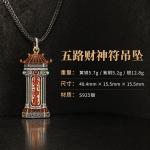
This piece is cut to the talisman shape: a long rectangle, wider at the top and narrower at the foot, with a raised line following the edge. The characters stand in vertical columns, one pressing against the next, cut shallow enough to be read only against the light. After the antiquing the recesses go black and the characters look inked, so that from a distance it does resemble a brushstroke on paper. The cool ground of the silver suits that ink colour better than plain white silver would, and it does not look new. The line at the edge is there to keep the face from feeling soft; one line and the whole plaque stiffens.
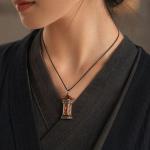
Worn on the body, this shape is often paired with a red cord. Red is the colour that turns things aside in folk custom, and with a talisman it makes a set. Tie it with a flat knot rather than a slip knot, which works loose and can be lost without your noticing. Silver against red is a slight clash that settles with familiarity. Keep the cord short: the talisman should hang a little above the heart and not swing as you walk. A red cord darkens as it soils; replace it every six months or so, before it fades to pink.
This is not a subject for asking specific things of. The wealth deity in folk usage is a hope rather than a contract — door gods pasted up at New Year, the wealth deity welcomed in, all of it for the noise and the spirits rather than for a signed agreement. Bought as a gift for a friend in business, saying it is for a smooth run is enough; say more and they will not know how to answer. The antiquing sits in the recesses, so do not scrub at the characters. Whiten them and the age goes out of the piece. Antiqued silver also dislikes sweat: worn against the skin through a summer it will go patchy inside a month, and what goes is the patina, not the silver.