


Menu
By theme
By theme







{{ variable.name }} : {{ variable.values[selectedVariantsIndex[variable_index]].name }}
Quantity:
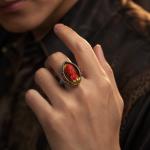
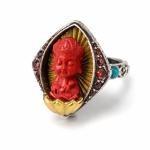
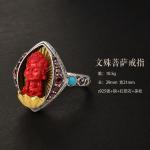
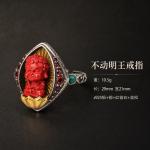
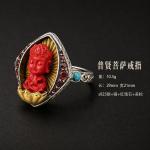
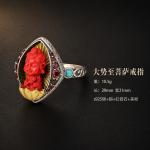
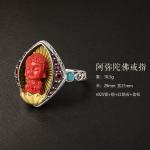
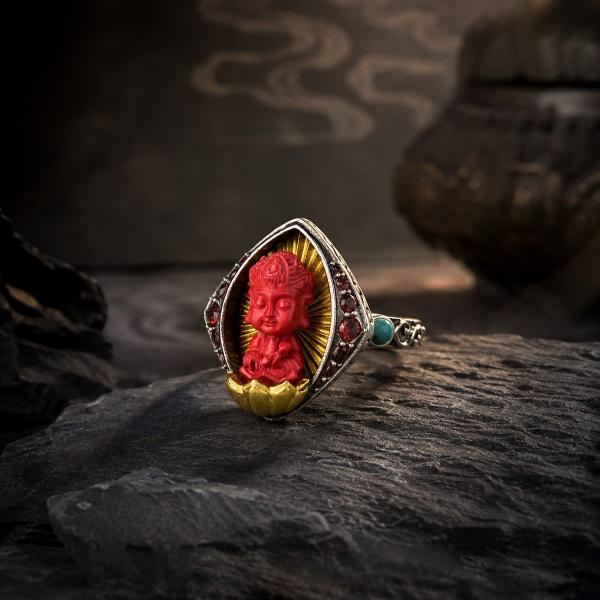
One design is made with six heads: Thousand-Armed Guanyin, Manjushri, Amitabha, Akashagarbha, Samantabhadra and Mahasthamaprapta. All six are half-length figures cut into the face of the ring at the same width, and they differ only in the crown and in what the hands hold. Laid out on a tray they look much the same, and only in the hand can you tell them apart, which is exactly where this kind of ring is easiest to buy wrong. All six are open, so there is no size to choose, and that removes one difficulty before you start.
How should you choose? Some go by the zodiac, some by whichever figure they feel closest to, and some simply by whether the face has been cut pleasingly. All three are legitimate and none is better than another. If a piece of advice is wanted, take the one you can recognise at a glance; one you cannot recognise sits awkwardly on the hand, and in time it ends up in a drawer. Lay all six out and look through them once: usually the first one your hand goes to is the one. The zodiac correspondences differ between versions, so do not put too much weight on them.
The face of the ring is wide, so there is area enough for the carving and the outline of the head can be kept. Brows and eyes are cut shallow, the bridge of the nose raised a little, the mouth a single line. White silver does not flatter fine detail; everything depends on light and shadow, and at the wrong angle the face is a flat plane. The antiquing helps here, holding the recesses dark so that the features come forward; tilt the light and the eyes arrive. Silver polished too bright looks worse, as though a film had settled on it. Fine scratches appear on the face with wear, which is normal, because that is where the hardness of silver sits.
The open design is a practical one for a ring. Fingers are slimmer in the morning and fuller at night, and they swell in summer more than in winter; an open band follows that. The drawback is that the load concentrates on the two sides of the gap, and hairline cracks will eventually appear; when you see one, change the ring rather than forcing it on, because a break will cut. Do not lift anything heavy while wearing it: silver is not strong enough, the face distorts, and once it has distorted the head sits crooked. It is not a wedding ring, but for everyday wear there is no problem.
A silver ring worn all day goes through handwashing and washing-up with you, and soap collects in the cuts and dries white. Once a week, brush it with a soft toothbrush and clean water, then blot it dry. Do not use kitchen paper, whose fibres catch in the cuts and leave the surface fuzzy. Sweat from the hands tends to be acid, so silver dulls on some people quickly; that is a matter of body chemistry rather than of the silver being poor, and the same ring on another wearer may go six months without darkening. Do not leave it on the washbasin when you take it off; the damp there will dull it inside a week.