


Menu
By theme
By theme


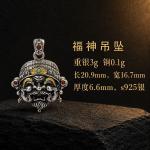
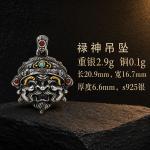
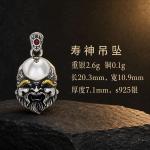
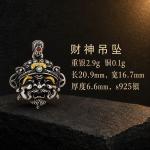
{{ variable.name }} : {{ variable.values[selectedVariantsIndex[variable_index]].name }}
Quantity:
Fu, lu, shou, xi, cai: five words that unpack into five things — blessing, position, long life, joy, money. Folk practice grouped them because any one of them on its own leaves the picture incomplete, and only the full set feels finished. New Year prints carry a different five blessings, the ones set out in the Book of Documents: long life, wealth, health and peace, the love of virtue, and a good end. Those are not these five figures, and the two sets get mixed up constantly. Keep them apart when you explain it, or the person listening will remember it wrong.
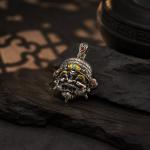
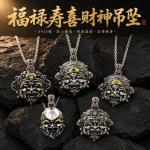
This set is five small figures, each holding its own attribute. The deity of blessing holds a ruyi, or sometimes the character for blessing; the deity of position holds a tablet, with a deer standing at his feet for the pun on lu; the deity of long life has a high forehead and carries a peach; the deity of wealth holds a sycee; the deity of joy is smiling, with his hands empty. Recognise a figure by what it holds first, because the five faces are much alike and the faces alone will not tell you. People often ask which figure belongs in which position; there is no fixed rule, and a strand with all five on it is perfectly acceptable.
Joy is the exception. Folk practice mostly did not make images of him at all: at a wedding the direction was taken from the almanac and he was welcomed from there, and painted figures are rare. This piece gives him a smiling face, which fills the place and lets the five stand as a row. The trade calls this making up a set, and the weakest figure in a set is often where the design shows most; fill the gap clumsily and the whole set falls apart. Of the six designs, joy sells least. Plenty of people ask about it; few take it home.
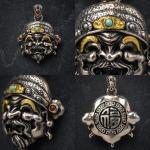
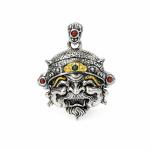
The relief is kept low. All five sit on one plane and none of them pushes in front of the others. A key-fret band runs round the edge, one line folding back and forth without breaking, which carries the sense of something continuing. The key-fret is the least troublesome and steadiest border in Chinese work, and with auspicious subjects it never oversteps. How tightly it is spaced depends on the size of the plaque: too tight and it stifles, too open and it scatters, and the run along the middle is where the eye is tested. The surface is antiqued, recesses dark and raised passages bright, which is what separates the drapery of five figures standing shoulder to shoulder.
Each of the five means something on its own, and only together do they make a group. Some people want the wealth deity alone; others add to the set as the household needs, filling in whichever is missing. A full set is a heavy gift and depends entirely on the recipient; for an ordinary friend, one is enough. Silver plaques knock easily, and the forehead of the long-life figure is the most exposed point on any of them and the first to suffer. Store them face up, with nothing resting on them. Keep all five in a box with compartments rather than stacking them, because silver is soft and a night under weight will leave marks.