


Menu
By theme
By theme




{{ variable.name }} : {{ variable.values[selectedVariantsIndex[variable_index]].name }}
Quantity:
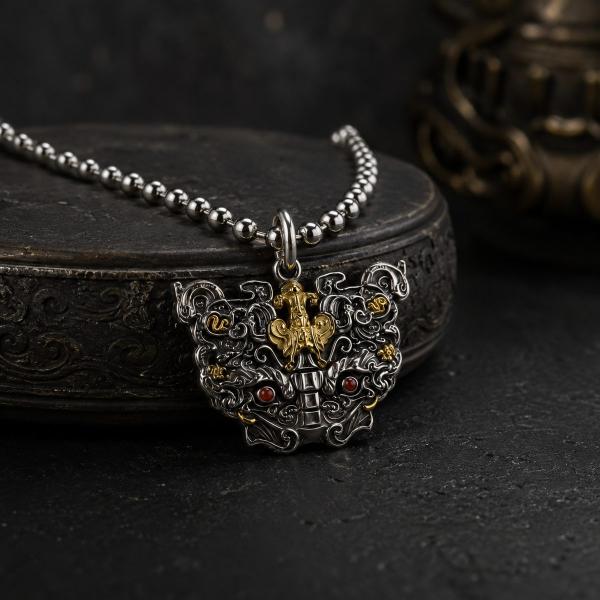
The taotie is the commonest animal mask on Shang and Zhou bronzes. A face spread out frontally and symmetrical, with large eyes, horns and fangs, and almost no body — at most a tail trailing away at either side. The Lüshi Chunqiu has a line about the Zhou ding bearing the taotie, a head and no body, and later readers took the phrase and gave the motif its name. Masks on bronzes were cast, heavy and protruding, which is not the same work as the shallow cutting on later silver.
Calling it a taotie was a decision made by Song antiquarians reading old books. What the people of the Shang and Zhou called it is not settled. Some say an ox head, some a tiger, some a variant of the dragon. Excavation reports prefer animal mask, which is the safer term. It sounds mystifying when you first hear it, but plainly it is a glaring face set onto an object to hold the space. The argument over the name has no bearing on how it looks; the symmetry and the tension in it were worked out over several hundred years.
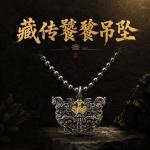
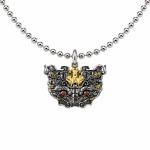
This one is made in the form of a silver lock, with a piece of South Red set into the body. The longevity lock in China is given to children, taking the sense of something locked in place. The hundred-family lock is the more concrete version of the custom: silver collected a little at a time from every household in the lane and made into one lock, meaning that a hundred families are watching over the child. Holes for the cord are left at the two ends, drilled through the side so that they do not show from the front. The custom exists everywhere, with local variations in practice and much the same meaning.
South Red is a branch of agate, warm in colour, called red jade in old books. Natural pieces carry cinnabar spots and banded threads to a greater or lesser degree and are never one flat, dead red; a stone that is too even is a reason to hesitate. The silver mount closes around the sides and leaves only the front showing, and half the weight in the hand comes from that stone. Red against silver holds its own without turning loud. South Red runs from deep to pale: deep goes dark in low light, pale looks young, so look at it in daylight before deciding.
Two things need watching when it is worn. The stone chips: struck against the corner of a table it will lose a piece, and the piece cannot be repaired. The claws of the mount should be pressed down periodically, because a setting that has loosened lets the stone shift, and a stone that shifts long enough will fall. South Red also dislikes heat, so keep it off a radiator and out of a sauna, since expansion and contraction will open the small cracks already in the stone. The silver takes a cloth as usual, working around the stone. Do not oil the inside of the mount; the oil seeps into the gap beneath the stone and darkens over time.