


Menu
By theme
By theme



{{ variable.name }} : {{ variable.values[selectedVariantsIndex[variable_index]].name }}
Quantity:
The Classic of Mountains and Seas describes the Qingqiu mountain and a beast there, shaped like a fox with nine tails, and adds a line saying that anyone who eats it is not afflicted by gu poison. The nine-tailed fox was not a demon at the beginning; it was an auspicious beast. On Han dynasty reliefs it often sits beside the Queen Mother of the West, in line with the three-legged crow, the toad and the jade rabbit, standing for good omen and for descendants continuing — many tails, many children. Nine can be read either as a large number of tails or as nine the extreme number, and both readings hold.
The fox was talked into a bad reputation later. Tales of the strange in the Six Dynasties have foxes taking human form, the tendency grew stronger through the Tang and Song, and by the time Daji walked on in Fengshen Yanyi the nine-tailed fox was fixed for good. An image travelling from auspicious beast to demon took two thousand years. That change is more interesting than the pattern itself, and it is a reminder that one symbol can be given opposite meanings by different dynasties. Qing dynasty notebooks were still arguing over whether the nine-tailed fox belonged among the auspicious beasts or the demons, and two hundred years of argument produced no verdict.
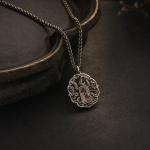
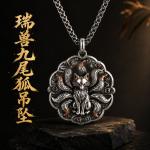
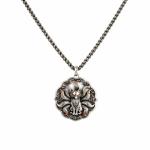
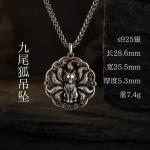
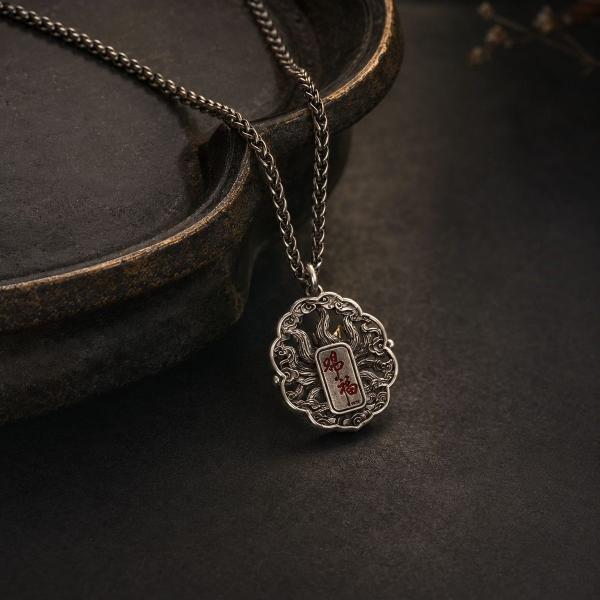
This one is a fox lying down, nine tails spread behind it like a fan half opened. With the antiquing, the recesses at the roots of the tails darken and the tips are left bright, so the nine separate cleanly. Nine tails are the difficulty of the piece. Spaced too evenly they look like feathers, scattered too freely they are a mess, and they need to sit in front of and behind one another, one pressing and another yielding, or they look as though they had been inserted afterwards. The roots all have to start from a single movement of the design. Start them loose and the whole fan floats.
Folk practice also has a fox immortal tradition: in parts of the north, tablets are kept to fox immortals for the peace of the household, and that is not the same thing as the auspicious beast in the Classic of Mountains and Seas. Two sources, two accounts, and mixing them muddles both. Most buyers like the shape for its own sake, the nine tails spread out, and it is safer to ask which tradition is meant before explaining it. Fox immortal tablets are found mostly in the northeast and north China, and the tablet is inscribed Hu xian, using the surname rather than the word fox.
The tips of the tails are the finest part and the most easily damaged. A knock will not break them but will bend them, and a bend can be eased back a little; work it too often and the metal fatigues and breaks anyway. Antiqued silver should never go into dip, because the patina goes altogether and the layering of the tails flattens with it. Lay the pendant flat when it is not being worn rather than letting the tails hang under pressure, which sets them overnight. Silver is soft, so a bent tail can be straightened slowly; warm it in the palm first, because cold silver is brittle.