


Menu
By theme
By theme








{{ variable.name }} : {{ variable.values[selectedVariantsIndex[variable_index]].name }}
Quantity:
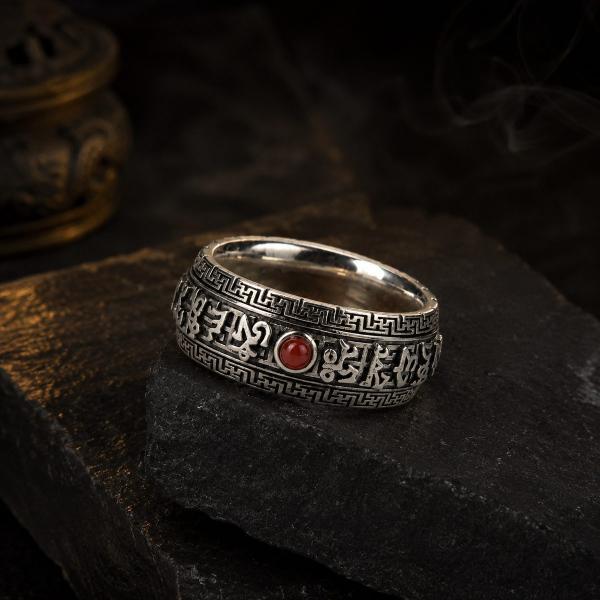
A spinning ring has three parts in construction: an outer band, an inner band, and an axle between them. The outer band carries the carving, the inner band sits against the finger, and the axle is what allows the outer one to turn. Done well, a push of the fingertip sends it round with a little resistance rather than free-spinning; done roughly, it grinds after two turns and rattles when it moves. The clearance between the three layers is the real test: a fraction too wide and the ring wobbles, a fraction too tight and it jams. The axle is usually a tube with a pin through it, riveted at both ends, and how tightly those rivets are set decides how the ring feels.
On this ring the outer band is Yellow Jambhala, with a piece of South Red set at the front. The deity is cut into the outer band, so turning it is like a small picture passing slowly before the eye, travelling round the finger. The South Red sits directly over the back of the finger, the most conspicuous point on the whole piece, and the transition from red to silver is held by a bezel instead of claws, which are too conspicuous on something this small. The wall of the outer band has to be thick enough: cut thin where the figure is and the metal shows through, and it distorts as it turns.
In Tibet, Yellow Jambhala belongs to the five Jambhalas: yellow in body, the right hand holding a wish-fulfilling jewel, the left cradling a mongoose that disgorges jewels. The five are divided by colour and by direction, and the yellow one holds the centre, which is why he is often placed in the middle of the row at a monastery entrance. These are conventions of iconography and they are useful for recognising him; there is no need to read anything further into them. He is usually seated, with the two attributes to left and right, so read the hands first and then whether he is seated.
Turning has a ready counterpart in Tibetan practice: prayer wheels and hand wheels, turned by hand while the mouth recites, so that hand and mouth both have something to do. Turning a ring is less solemn than that, closer to an occupation for the fingers — two turns in a meeting, while waiting for someone, while thinking something through — and the mind has somewhere to settle. Turn it in the usual direction; against the direction does no harm, it simply goes against the habit. Use the pad of the finger rather than the nail: oil from under the nail works into the axle and is harder to clean out than dust.
Two sizes are offered, 17 and 20, and the shank is open and adjustable, so a thick knuckle can still get in. Adjust it slowly. The axle assembly dislikes being forced sideways, and bending too quickly will skew it, after which it turns stiffly. If dust in the axle makes it drag, do not oil it; oil attracts dust and the drag gets worse. Pinch the ring with a dry cloth and turn it a few times and the dust comes out. South Red chips, so take the ring off before moving furniture. After adjusting, the axle carries some load, so turn it once to test and adjust back if it drags.