


Menu
By theme
By theme



{{ variable.name }} : {{ variable.values[selectedVariantsIndex[variable_index]].name }}
Quantity:
The hydrangea is also called the eight-immortals flower, and its head is not one flower but dozens of small ones pressed together, reading as a single ball only at a distance. What actually opens is the outer ring, the sterile florets, which have no stamens in the centre and rely on colour to draw insects in. The small ones inside are the fertile florets, the ones that set seed. Two kinds of flower with a division of labour inside one head is something not many people know, and saying it out loud is often met with disbelief. The size of the head depends on the variety: a large one can be as wide as a small bowl, a small one no bigger than a thumb.
The colour follows the acidity of the soil. Acid ground gives blue, alkaline gives pink, and move the same plant into another pot and next year the colour will be different. Anthocyanins are what lie behind it, and the amount of aluminium ion available decides which way it goes. This is usually passed around as a curiosity, and it is in fact the most basic rule in horticulture; growers use it to set their colour, and it works more reliably than feeding. The same holds within one plant, where flowers on new wood come redder and those on old wood come bluer.
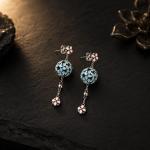
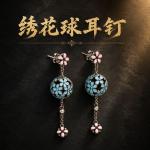
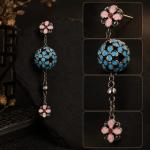
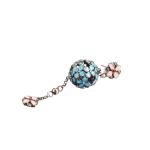
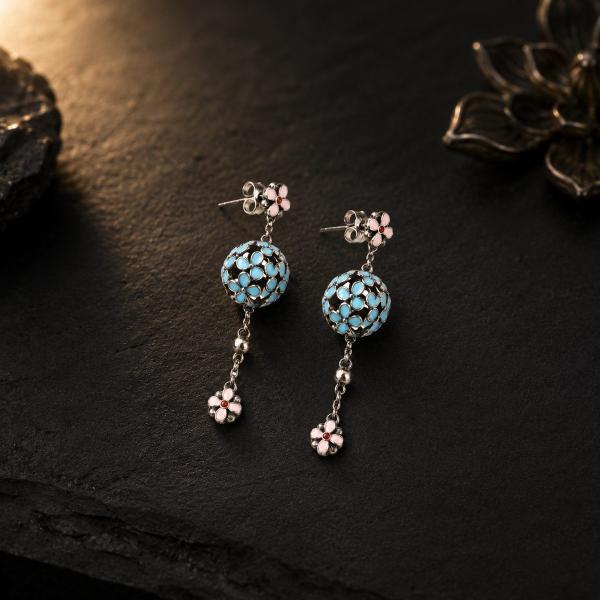
This pair breaks the head into layers: large petals on the outer ring, small ones inside, and openwork between them so that light passes through the gaps. Enamel fills the petals in three depths, pale at the outer edge and deep at the centre, and with the colour pressed in like that the ball rounds out. The openwork is cut in the gaps between petals and not into the petals themselves, which would collapse once they were pierced. The edges of the petals are given a rise and fall rather than being cut flat, so that light passing across them keeps a little softness.
Among the subjects used for studs, flowers are the least particular. A younger wearer does not look old-fashioned in them and an older wearer does not look frivolous, and a gift needs no matching of recipient at all. Hydrangea flowers in summer, and it is mostly worn in summer; against plain clothing the colour does not fight. There is no need to think the combination through — put it on and you know. Anyone with small lobes should take a size down: once the ball is wider than the lobe itself, it has nothing to sit on.
Enamel glaze has thickness to it and will chip against a hard object, and a chip shows the silver underneath very plainly. Dust and foundation collect in the openwork. Use a cotton bud with clean water and dab at it; do not poke with a toothpick, which scratches the edge of the glaze. When the silver darkens, work the cloth around the outer rim and keep it off the colour. Store the two wrapped separately so that the posts do not face the enamel. And do not leave enamelled pieces sitting in water; the glaze takes up water and goes cloudy.