


Menu
By theme
By theme

{{ variable.name }} : {{ variable.values[selectedVariantsIndex[variable_index]].name }}
Quantity:
Turquoise appears very early in Chinese jewelry. A tomb at Erlitou in Yanshi, Henan, yielded a turquoise dragon: more than two thousand small square pieces set into bronze and fitted into a dragon with an arched body, each piece polished to a curve. From a distance it reads as a single sheet; up close it is all seams. Turquoise was the main material then, not an accent. Later it travelled west and became the lead stone in Tibetan and Mongolian jewelry; travelling east it reached the scholar’s desk, cut into mountain-shaped ornaments and brush rests. One stone, several uses, and a different temper in each. Old pieces often carry iron lines, dark brown veins running through the stone. Some collectors seek out the veined pieces and say that is what natural looks like; others accept only a clean face. On a small inlay, whether the matrix reads clearly has to be checked close up, in the hand.
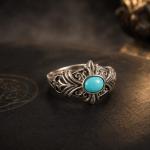
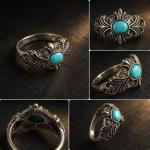
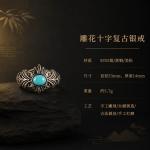
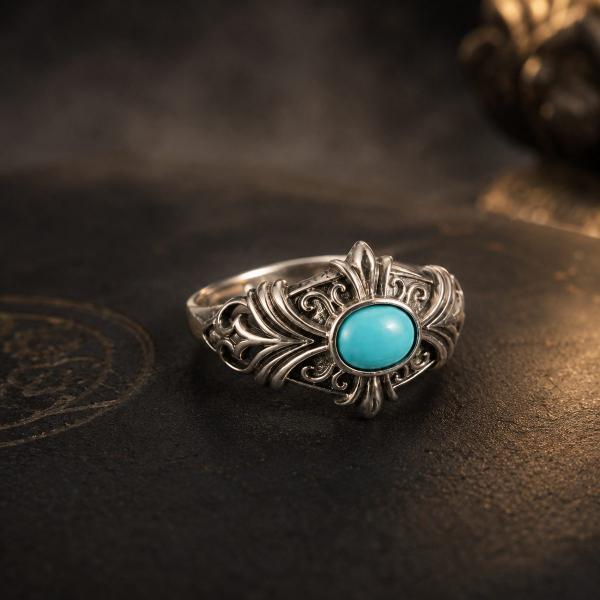
This one grinds the turquoise to a dome, sets it into the face and wraps a rim of silver around it. Turquoise chips, and a bezel is steadier than prongs: a brush against a table edge won’t take a bite out of the stone. The band is carved with scrolling vines and curled grass, the pattern pressed shallow, so a fingertip finds the rises without being scratched. The open structure allows a little adjustment, a size or two either way, and you can bend it yourself. Don’t do it over and over. Silver fatigues, and too much bending raises a hairline crack at the opening.
Turquoise changes colour. Sweat, oil and sun will turn it greener and deeper over a year or two. Some people cultivate that shift on purpose; others like only the sky blue it has when new. The stone is porous, so don’t soak it and don’t wear it in the shower. Spray perfume first, and put the ring on once it has dried. When the silver rim dulls, press it with a soft cloth. Keep toothpaste away from the turquoise: abrasive grains work into the pores and don’t come out, and that patch turns cloudy in a way no polishing will fix.
The option is listed as a “Chrome Hearts ring”. That is the supplier’s name for the style, meaning the cross-and-thick-edge school of work. It has nothing to do with that brand, and it is not that company’s craftsmanship either. The term has circulated among silver dealers for a long time and I recorded it as it came. Don’t open the parcel expecting brand quality. Where the name and the photograph disagree, trust the photograph; I make no claim about any brand here.
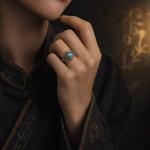
As a gift this one is easy. The open band means no ring size to measure, and it suits men and women alike. On a slender finger it will hang a little; turn the carving toward the palm and leave only the plain rim showing. It ships as a single piece, so a pair means ordering two. Bright silver looks best against dark clothing; with pale colours it reads thin, and that is the turquoise’s colour deciding, not the design.