


Menu
By theme
By theme


{{ variable.name }} : {{ variable.values[selectedVariantsIndex[variable_index]].name }}
Quantity:
A talisman is not a drawing made at random. Daoist talismans follow a framework: the head honours the Three Pure Ones, the belly conceals a name, the foot closes the stroke, and the characters in the middle are often several words compressed into one, a composite sacred name. To someone who doesn’t know, it looks like a tangle of thread. Someone who does can tell from the first stroke which lineage it belongs to. Shrunk onto a ring, only the outline survives; pack the strokes any tighter and they smear, which is why small pieces are judged on whether the lines are clear. How many motifs a piece carries is a separate question. Old talismans were drawn on yellow paper and also cut into peach wood, and the idea that peach wood wards off evil is older than the talisman itself. Moving them onto silver is a matter of the last few decades, for the sake of wearing one every day without its falling apart: paper and wood both give way to sweat.
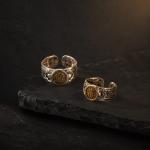
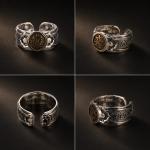
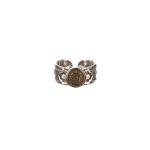
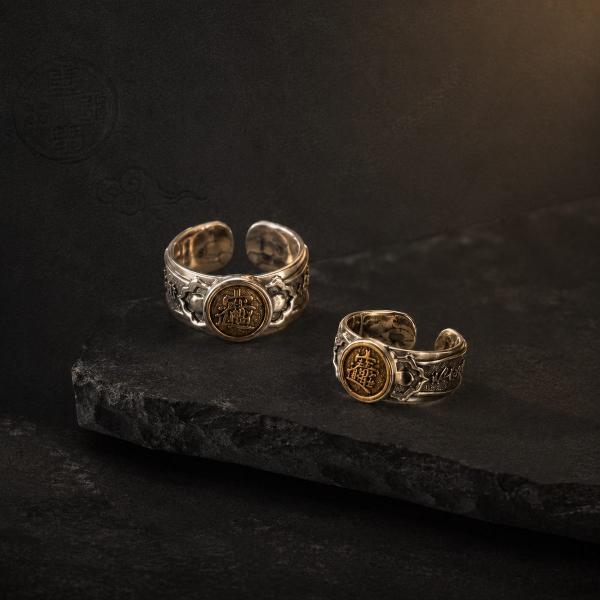
The face carries the talisman at its centre, with auspicious clouds at the sides. Cloud patterns were used on objects very early. The cloud-thunder scroll of the Shang and Zhou was square-cut and angular; after the Tang and Song it turned into the curling cloud, and curled its way onto porcelain, brocade and painted beams. “Auspicious cloud” is a later colloquialism. The old names were qingyun and qingyun, written with different characters, and the ancients read the colour of clouds to judge the harvest, because clouds were the sky’s expression. Setting a talisman beside clouds adds a background of heaven’s timing to an order.
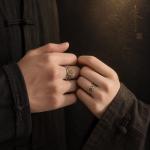
Men’s and women’s versions are two separate options, stocked separately in the back end. Choose by name and don’t guess from the main photograph. The open structure means it ignores ring size; index and middle finger both work, and on the ring finger it sits looser. Bright silver throws a lot of light off the knuckle, and a wider face holds its own there, while a narrow face looks more delicate and suits a slim hand. I usually suggest the hand you don’t work with. Typing and washing up are no trouble, and it won’t be knocked about every day.
Daoism has more than one God of Wealth. Zhao Gongming is the martial one, Marshal of the Xuandan Altar, black-faced and thick-bearded, riding a tiger and holding a whip. The five-direction gods divide east, south, west, north and centre between them, and folk tradition keeps a civil line as well, with Bi Gan and Fan Li among its number. Which one a talisman honours is read from the group of characters in its belly. Smudge those strokes and the name is gone, leaving only pattern, which is what small talisman pieces most often lose.
A silver talisman ring fears sweat. Wear it for a day in summer and the band of skin beneath goes black. That is ordinary oxidation, and a wipe with a soft cloth brings most of it back. Don’t dig at the dark that collects in the recesses; that darkness is exactly what sets off the strokes, and polishing it all bright makes the talisman unreadable. Store it in its own bag, away from keys and coins, since one knock leaves a dent. The inside of the band should be cleanly finished too: if the talisman edge scratches there, a day of wear is unbearable.