


Menu
By theme
By theme







{{ variable.name }} : {{ variable.values[selectedVariantsIndex[variable_index]].name }}
Quantity:
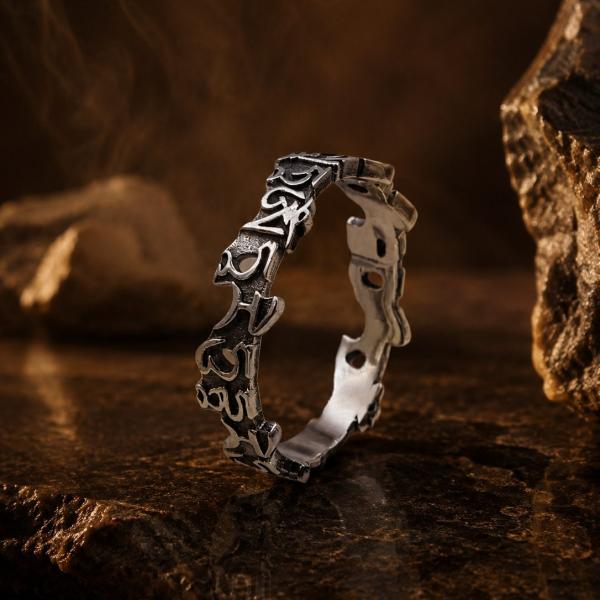
A mantra runs in a circle, and the start has to meet the end, which is harder than carving a few characters. The spacing must be even around the whole circumference, the cuts must be the same depth, and the join cannot suddenly crowd. Making this kind of ring means working out the circumference first, then the spacing, and only then cutting. Half a character out and the whole circle leans, and there is no repairing it: silver can go back into the crucible, lettering cannot. A mantra ring holds only so many characters. Around one circumference each gets a millimetre or two, and the graver has to hold steady through every turn. Lose it and the edge chips away.
Green Tara is the figure recited most often in Tibetan Buddhism. Her body is green and her right foot steps forward to show swift action; her left hand holds an utpala flower whose stem runs up her arm and opens at her ear. She heads the twenty-one Taras, and the tales of rescue from the eight dangers all attach to her. The mantra is short, om tare tuttare ture soha, and older people in Tibet recite it the way beads run through the fingers, fast and unbroken. It is written in Tibetan, in Sanskrit transliteration and in Chinese transcription, and the three take up different amounts of space. Chinese transcription takes the most, so a full circle cannot hold much, and Chinese versions usually carry only the opening syllables.
Worn on the hand, the letters are for the wearer. There are two ways of cutting them, incised and raised. Incision saves material and the grooves collect dust; raised work costs more time and the standing strokes wear down. Narrow grooves fill with sweat and dust over the years and look as if they have been painted black, and a rinse takes it off. Don’t pick at them with a needle, because a scratched groove goes blunt.
The opening usually sits at the seam in the mantra, and once the ring is on, the seam faces the palm and the front reads as one continuous band. On a larger finger the opening spreads and the spacing shifts with it, and there is nothing to be done about that; every open mantra ring behaves the same way. If it bothers you, turn the opening to the side, or measure your size properly before ordering.
People who give this ring usually know what the recipient recites. If you don’t, don’t give it blind: a mantra is not decorative pattern, and what the wearer cares about is whether it is correct. One wrong character changes what the whole object means. Silver oxidizes, and the dark in the grooves sets off the strokes, which is an advantage, so don’t polish it too hard. The size of the opening matters too. Wide enough to pass the knuckle is enough; too wide and the band goes oval, and once it turns on the finger the letters sit crooked.